

to eat away
 17
4.1
17
4.1

- phrasal verb
- Indeed, inflation has eaten away at the real value of pensioners' benefits over the years.
- continue to eat away
Loading YouTube…
Watch on YouTubeAnd then they just put a wash of the, the hydrofluoric acid on it and it would eat away into it and etch it.
- And then they just put a wash of the, the hydrofluoric acid on it and it would eat away into it and etch it.
- But if you hang on to those regrets in the manner where they eat you away or use those regrets to keep you doing the right, that's what I do.
- Fatigue, stress, pressure, lack of resource, lack of time, lack of money, and over the course of a day, it kind of eats us away.
- They thought that that was what an eclipse was was was taking place, an invisible dragon eating away at the sun.
- And you just think I waste so much time worrying about such menial, pointless things that really eat away at me.
- Maybe they miss that person more than they typically should, but it's the feeling of loneliness that also eats away at them.
- Whatever chemicals are in that spider to eat away flesh.
- But if you guys don't control it, it can spread start to rot your dragon fruit branches and it will start to eat a flesh away.
- You become this massive burden on them because you chose to eat away your pain, to try and use food as a way to numb yourself and to self hate.
- It's a fungus that actually will will try to eat away at some of the skin on the on the squash.
Examples
-
Certain chemicals can eat away at the surface of the stone, causing permanent damage.
-
In my opinion, advisors with high fees are eating away at their clients' nest eggs.
Blog text (26) -
I tried not to think about it, but it ate away at me for the next few hours.
Blog text (34) -
Folks like to say that, well, cash gets eaten away by inflation.
-
The cab driver's banal remarks had eaten away at me.
Fiction book (1990) -
And you just think I waste so much time worrying about such menial, pointless things that really eat away at me.
-
Your courage in exposing the corruption that eats away at this institution is commendable.
Fiction book (1992) -
Rust can slowly eat away at metal, making it weak and unusable.
-
The powerful waves eat away at the cliffs year after year, reshaping the coastline.
Synonyms
 564
6.6
564
6.6
Gradually use up money or fuel
 83
4.2
83
4.2
Gradually make someone's trust, belief, or support weaker over time
 29
6.0
29
6.0
Break into smaller parts by losing energy in a physical process, for example in an atom
 27
4.0
27
4.0
Remove an outside layer or covering from something to show what is under it
 25
4.4
25
4.4
To damage something slowly over time, for example a building or a person's confidence
 24
4.2
24
4.2
To make something smaller or weaker by removing small parts slowly
 18
4.9
18
4.9
Gradually make someone feel worried or less confident
 18
4.6
18
4.6
Gradually make something weaker by repeated small actions
 16
4.2
16
4.2
To slowly become weaker or fall apart because it is not cared for
 14
7.1
14
7.1
Gradually make someone feel worse or less confident
 8
4.3
8
4.3
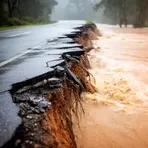
Carry away soil or roads by strong flowing water
 3
5.9
3
5.9
To make something smaller gradually by cutting or wearing it away
 2
3.8
2
3.8
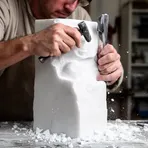
To slowly remove material by rubbing or long use
 1
6.7
1
6.7
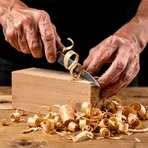
Wear away skin or material by rubbing
 1
5.4
1
5.4
To remove small pieces from something slowly by steady effort

Wear away the surface of something by rubbing or scraping
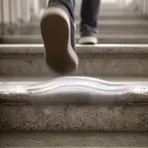
To wear a surface down by rubbing

To wear away a surface slowly by rubbing

To rub something so it becomes damaged at the edges
Antonyms


How Damaging

Surface Forms
Morphology
The sense 'to gradually wear away or erode' is directly derivable from combining 'eat' (to consume/use up) with 'away' (indicating removal or disappearance); the particle adds a sense of progressive removal that is predictable. This verb+particle pattern is a common compositional metaphor in English (and has parallels in other languages), so a B1 learner who knows both constituents would very likely infer the meaning.
Etymology
The phrasal verb eat away also paints a picture of something like doubt, rust, or worry slowly eating at a person or object and taking strength away a little at a time. That's why it now means 'to gradually wear away or erode'.