
Difficulty
How difficulty is calculated in Glite Dictionary
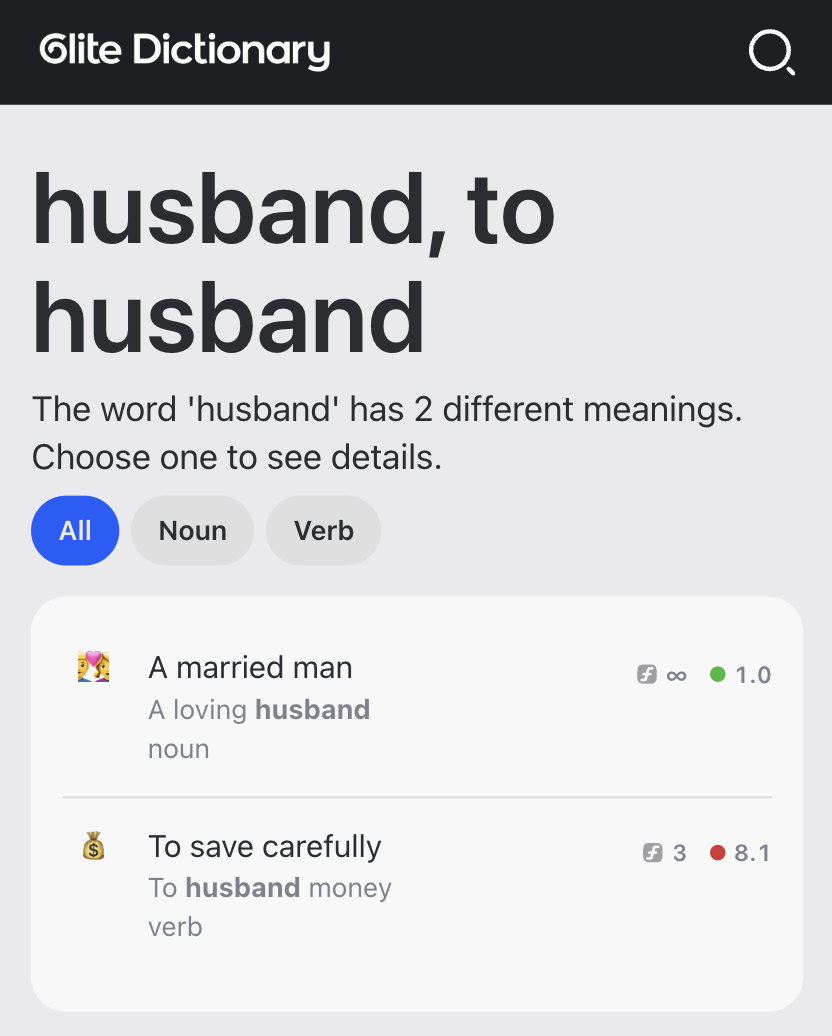
Why can husband be both easy and hard?
As a noun, husband is basic: a married man. As a verb, in a sentence like "They husbanded their resources," it means to save and manage something carefully.
Same spelling. Different meaning. Different difficulty.
The score starts with real test answers
Glite difficulty is based on results from the Glite Vocabulary Test. Millions of people from more than 100 countries have completed vocabulary tests on Glite, giving us a large signal about which English meanings learners know and which ones they miss.
This matters because a dictionary entry is not just a spelling. It is a set of meanings. Glite measures difficulty for individual senses, not only for the headword.
Why not just count the percentage who knew it?
A raw percentage sounds simple: if 80% of people know a meaning, call it easy. The problem is that every test group is different. One question may be answered mostly by beginners. Another may be answered mostly by advanced learners.
So Glite uses item response theory, often shortened to IRT. In plain English, IRT looks at both sides of the answer: how strong the learner seems to be and how hard the question seems to be.
That makes the score more stable than a plain percentage. It helps compare meanings even when different learners saw different questions.
If you want the technical background, Wikipedia also has a short page on the Rasch model, one common model in this family.
Why measure the meaning, not just the word?
Learners do not struggle with letters on a page. They struggle with the exact meaning in front of them.
Run as "move fast" is easy. Run as "operate a company" comes later. Run as "a color spreads in wet cloth" is another case again.
That is why Glite Dictionary shows difficulty sense by sense. The question is not "do people know this spelling?" The question is "do people know this meaning?"
What the 1.0 to 9.9 scale means
The public badge turns the difficulty estimate into a simple 1.0 to 9.9 scale.
- 1.0 means almost everyone knows this meaning.
- Around 5.0 means the meaning is in the middle.
- 9.9 means almost no one knows this meaning.
The color follows the same idea: green for easier meanings, yellow for middle meanings, red for harder meanings.
Why difficulty is not frequency
Difficulty is not the same thing as frequency. Frequency asks, "How often will I meet this meaning?" Difficulty asks, "How many learners know it when they meet it?" The two often move together, but they can split. Datum, gee, and plaintiff show up enough to matter, but many learners still miss them. Kilogram, positive, and paracetamol are much rarer, but they can be easier because the form is mathematical, transparent, or familiar across many languages.
Use difficulty together with frequency. A rare hard meaning may be safe to ignore for now. A common hard meaning deserves a second look.
The score is not a judgment of you. It is a map of where English usually becomes harder for learners.
Measure your own vocabulary size
If you want to see where you stand, take the Glite Vocabulary Test. It estimates your vocabulary size and helps Glite improve difficulty scores for future learners.
Take the vocabulary test
