

to tear off
 12
3.0
12
3.0

- phrasal verb
- /tɛr ɔf/
- Barbara reaches in to tear off an airline baggage I.D. ticket attached from the previous flight.
- tear off your clothes
- tear off a piece
- tear off a sheet
Loading YouTube…
Watch on YouTubeHis face had been torn off while he was still alive.
- His face had been torn off while he was still alive.
- He says, just tell him if you, you, you can't tear off that scab.
- Think of it like no Batty do you want to fucking go plant corn, water it, have the sun fucking beam on it, raise it, and then so I can tear off the husk?
Examples
-
And then you tear off the tape on the actual cover.
-
The bartender jots it down on a pad, then tears off the carbon slip.
Fiction book (1997) -
Put it in your mouth and tear off the meat.
-
Here, you tear off pieces And I'll put them on.
-
SLAMS the car into drive and tears off down the street.
Fiction book (2000) -
The roof of the farmhouse had been torn off and burned for fuel during a bad winter.
Fiction book (1998) -
The others were watching "Gentle Giant" and tearing off pieces of pizza from the box lid.
Fiction book (1992) -
John pulls a roll of duct tape from his knapsack and tears off a piece.
Fiction book (1991) -
The bartender plops the sandwich on a plate, tears off an order slip.
Fiction book (1997) -
He had to tear off the bandage quickly to avoid further pain.
Synonyms
 ∞
1.0
∞
1.0
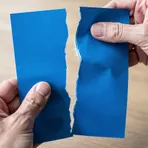
To pull something so it breaks into pieces
 ∞
1.5
∞
1.5
To remove clothes or something from your body
 523
2.7
523
2.7
To take something out of a place, often with effort
 196
4.1
196
4.1
To pull something suddenly and hard
 190
4.1
190
4.1
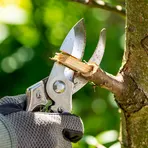
To remove something by cutting it away from what it is attached to
 80
4.5
80
4.5
To pull something away quickly and roughly
 77
3.5
77
3.5
To pull something out quickly with the fingers
 68
4.4
68
4.4
To pull something out quickly and with force, often to remove it completely
 45
3.4
45
3.4
To remove something by cutting, often with a sharp blow
 41
2.7
41
2.7
To take something off from where it is attached
 28
2.8
28
2.8
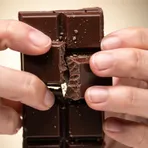
To make a piece come away from something by hitting or bending it
 24
4.8
24
4.8
To pull something out with force
 16
3.9
16
3.9
To take something off from what it is connected to
 12
2.1
12
2.1
To remove a piece from something using the teeth
 11
2.8
11
2.8
To take off quickly and easily, especially clothes or small items
 11
3.4
11
3.4
Remove a cover or layer by pulling it away slowly
 10
8.7
10
8.7
To pull something apart with great force
 9
4.3
9
4.3
Pull things away one at a time
 9
3.7
9
3.7
To remove clothes or a cover completely and quickly
 9
3.5
9
3.5
To break a piece from something with a quick, sharp movement
 9
4.6
9
4.6
To cut a part from something with one quick move
 6
4.5
6
4.5
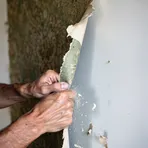
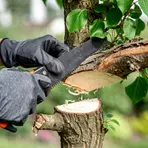
To pull something off quickly with force
 5
3.4
5
3.4
To remove a part from something with a knife or tool
 3
3.5
3
3.5
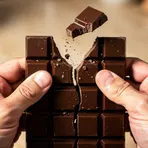
To bite something until it comes off
 2
3.5
2
3.5
To come off a larger thing, often because of force or damage
 2
3.7
2
3.7
To cut a small part off something quickly and neatly with scissors or shears
 1
4.4
1
4.4
To take a person or thing away quickly from a place

Pull something away suddenly with great force

To tear something into separate parts, usually by force

To take off or get rid of something quickly and without care
Antonyms

How Forceful

Surface Forms
Morphology
The meaning 'to remove something by pulling or ripping it violently' is directly and compositionally derived from 'tear' (to pull or rend apart) combined with the particle 'off' (indicating removal/separation). This follows a common English verb+particle pattern that is cross-linguistically frequent, so an average B1 learner who knows both constituents should be able to infer the MWE's meaning.
Etymology
Tear off comes from the clear image of ripping something away with one strong pull: you tear paper or cloth and it comes off. So it means 'remove by pulling or ripping something forcefully'.