
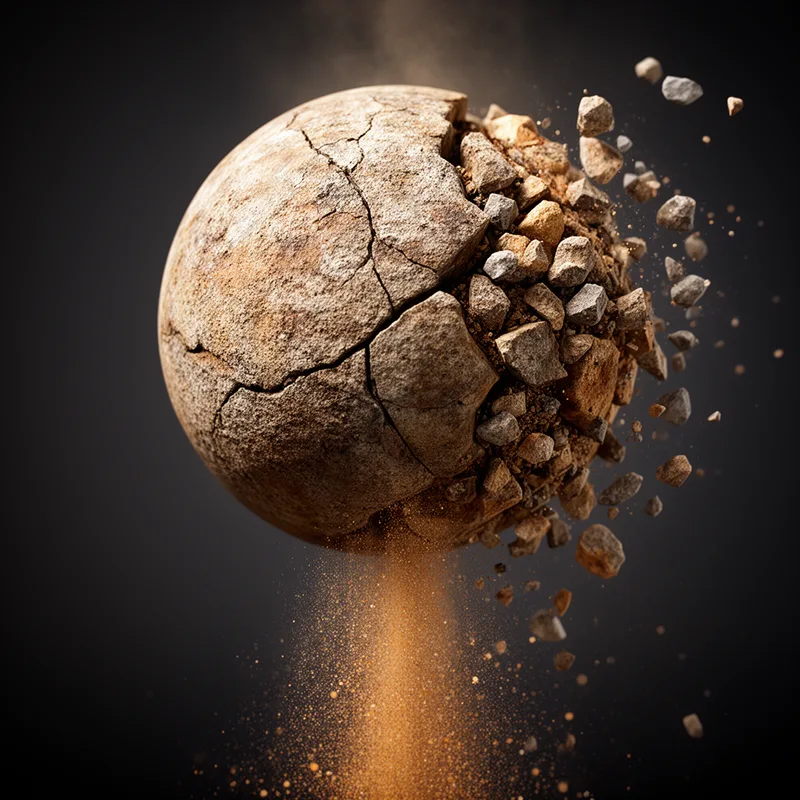
to disintegrate
 35
5.8
35
5.8

- verb
- /dɪˈsɪntɪɡreɪt/
- Experts on the country had predicted that the Yugoslav federation would disintegrate when Tito died.
- begin to disintegrate
- the regime disintegrated
- the union disintegrated
Loading YouTube…
Watch on YouTubeWell, Europe may be disintegrating from the European Community.
- Well, Europe may be disintegrating from the European Community.
- If that isn't there, then these standards will disintegrate as soon as he tests them.
- People's people are dying, people's people's livelihoods are disintegrating.
- The, the, the wall is disintegrating.
- Again, it's not going to suck anything in before it completely disintegrates.
- the United States of America didn't want the Soviet Union to collapse and disintegrate.
- I mean, it's quite easy to kind of for democracy to disintegrate into some kind of authoritarian regime.
- And that, as she says, if we keep pulling threads from the tapestry of life, it it will disintegrate and we will lose what sustains us and supports us.
- Your life is either coming together, you're you're integrating, or your life is falling apart, you're disintegrating.
Examples
-
During the first part of 1997, the country almost disintegrated as a result of bad politics.
Academic text (1999) -
I hate to see this group disintegrate, and I'm going to do everything I can do to stop it.
-
Why not let it disintegrate into two countries?
-
If the host community no longer supports the park, the partnership will disintegrate.
Academic text (2011) -
I mean, it's quite easy to kind of for democracy to disintegrate into some kind of authoritarian regime.
-
The union between Egypt and Syria, which took place in 1958, disintegrated in 1961.
Academic text (1992) -
I love this land of mountains and small islands, this narrow strip of earth that disintegrates into archipelagos.
Fiction book (2000) -
After years of infighting, the Golden Horde now began to disintegrate into rival Kanates.
-
He was nailing something in the cellar and the wood just disintegrated.
-
The ancient structure began to disintegrate after decades of neglect and exposure to the elements.
Synonyms
 ∞
1.0
∞
1.0
To change a large bill into smaller bills
 579
3.9
579
3.9
To fall down suddenly, for example when a person faints or a building breaks
 213
2.8
213
2.8
To separate something into smaller parts to explain or study it
 177
3.4
177
3.4
To break into small pieces or become weaker and collapse
 155
2.8
155
2.8
To break into pieces or stop working properly
 95
6.8
95
6.8
To break open suddenly and violently
 83
4.2
83
4.2
Gradually make someone's trust, belief, or support weaker over time
 72
2.8
72
2.8
To break suddenly into many small pieces, like glass
 66
2.7
66
2.7
Separate something into smaller pieces
 44
3.1
44
3.1
To break into pieces or fall into separate parts
 39
3.7
39
3.7
To break into small pieces or make something break apart
 30
4.4
30
4.4
To collapse inward, as a roof or organization breaking down
 28
2.8
28
2.8
To make a piece come away from something by hitting or bending it
 26
3.0
26
3.0
To separate into pieces, for example a machine or a group
 9
5.5
9
5.5
To break a substance into smaller chemical parts using heat or chemicals
 5
7.2
5
7.2
To fall apart or stop working properly after being stable
 2
3.5
2
3.5
To come off a larger thing, often because of force or damage
 1
7.0
1
7.0
To cause people or groups to separate
 1
9.9
1
9.9
To cut or separate something into parts, often by breaking it


 1
7.9
1
7.9
To make a group that was together become divided

To break something into many small pieces

To tear something into separate parts, usually by force
Antonyms


How Cohesive
90
3.4
 3
6.2
35
5.8
39
3.7
110
2.7
3
6.2
35
5.8
39
3.7
110
2.7
Surface Forms
Morphology
disintegrate = integrate (transparent) = dis + integr + ate
If a learner knows 'integrate' meaning 'combine into a whole', 'disintegrate' is readily understandable as losing that wholeness or unity.
Etymology
Disintegrate comes from the prefix dis- meaning 'apart' and the same root as integrity, meaning 'whole'. So, disintegrate often describes when a group, object, or idea loses its unity and falls 'apart'.