

to cast loose


 1
6.7
1
6.7
- phrasal verb
- /kæst luːs/
- Pass the word to cast loose the Carley floats.
Examples
-
The captain ordered the crew to cast loose the ropes from the dock to set sail.
-
- Cast loose the cannons!
-
Only when l put their words, their voices, to parchment are they cast loose, freed.
-
Before the storm arrived, they had to cast loose the lifeboats into the water.
-
To prepare for the race, the team had to cast loose the sails and get everything ready.
Synonyms
 ∞
1.8
∞
1.8
To let someone or something go free from being held
 ∞
1.4
∞
1.4
To stop holding something or someone so they are free
 344
1.1
344
1.1
Allow someone or something to leave a place
 337
1.0
337
1.0
To release someone or something that is held
 218
2.7
218
2.7
To let a person or animal go after keeping them in a place where they could not leave
 201
4.3
201
4.3
To suddenly let a strong feeling, power, or animal go free
 91
1.0
91
1.0
Make a knot or lace loose by undoing it
 88
1.0
88
1.0
Make something less tight so it can move or open
 82
5.3
82
5.3
To stop being part of or connected to something
 30
3.0
30
3.0
To let something go free or make it less tight
 22
7.6
22
7.6
Free a person or thing from something that traps them
 18
4.4
18
4.4
To have fun and act without control, or to remove someone from their job
 16
4.0
16
4.0
To come apart from something it is connected to
 13
3.8
13
3.8
Set something free from being held or controlled
 6
4.1
6
4.1
Remove chains and other things that hold someone so they are free
 5
6.5
5
6.5
Free someone or something from limits and control
 5
3.4
5
3.4
To open something by undoing a button or zipper
 4
5.7
4
5.7
To take off something that is attached to another thing, like a trailer or bicycle
 3
6.4
3
6.4
To free something by untying ropes or cords
 3
4.8
3
4.8
To get rid of something you do not want or need
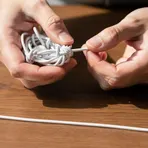 1
5.3
1
5.3
To free something twisted and knotted, like a cord
 1
6.6
1
6.6
To release something that is tied or fastened so it can move away
 1
7.0
1
7.0
To make something less tight or set something free
 1
6.1
1
6.1
To separate something from what it is connected to

To make something less tight or free it from something holding it
Antonyms


How Free
- Formal
23
7.0
 104
4.3
∞
1.0
1
6.7
16
4.0
88
1.0
5
3.4
104
4.3
∞
1.0
1
6.7
16
4.0
88
1.0
5
3.4
Surface Forms
Morphology
Both constituents contribute directly to the overall meaning: 'cast' (to throw off/get rid of) combined with 'loose' (to release or untie) yields the compositional sense 'set free/release'. This verb + resultative/adjectival element pattern is transparent and predictable to a B1 learner who knows the parts, so the meaning can be derived without prior exposure.
Etymology
Cast loose may come from sailors on ships. They would cast away the ropes so a sail or a boat became loose and could float free, and that image of letting go made the phrase mean 'to release' or 'to free someone or something from limits'.