
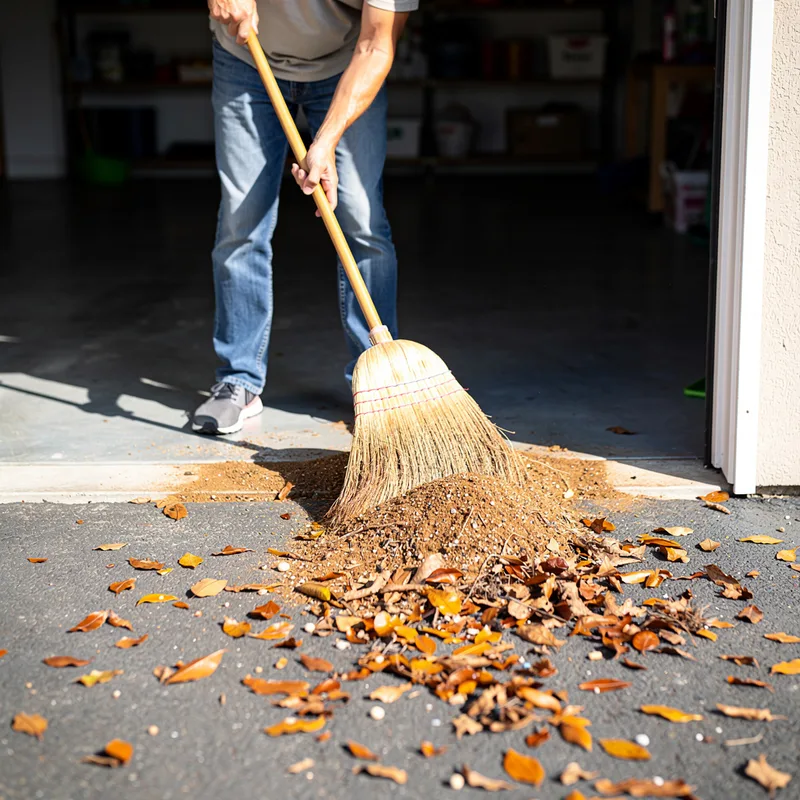
to sweep out
 1
2.2
1
2.2

- phrasal verb
- /swip aʊt/
- After helping the young men with their planting, Belle went home and swept out the chicken coops.
Loading YouTube…
Watch on YouTubeYou know, we're talking millions of tons of wild animals that are being swept out of the ocean that favor a few.
- You know, we're talking millions of tons of wild animals that are being swept out of the ocean that favor a few.
Examples
-
He decided to sweep out the old leaves from the patio to prepare for spring.
-
- Would you go sweep out the chicken coop?
-
I was sweeping out my garage when a guy walked up the driveway and asked, "Hey there, do you have a minute?"
Blog text (24) -
You will sweep out the church daily, and you will feed Vogel as one of your own.
-
Every morning, she would climb down from her warm bed atop the clay oven, eat a breakfast of bran porridge, and sweep out her one room with a broom made of sticks from the forest.
Fiction book (2000) -
Every Saturday, I sweep out the garage to keep it tidy.
-
Before the party, she will sweep out the living room to make sure everything looks nice.
Synonyms
 ∞
1.5
∞
1.5
To remove people or things from a place
 948
1.9
948
1.9
To remove something from a place or container
 433
1.0
433
1.0
To make a room or area free of dirt and tidy by removing mess
 260
1.0
260
1.0
To empty something completely
 242
1.0
242
1.0
To move a brush across something to clean or paint it
 227
1.0
227
1.0
To clean a floor or surface by brushing away dirt with a broom
 136
3.2
136
3.2
To remove something unwanted from a place
 127
1.9
127
1.9
To lift something using a deep curved tool or your hand
 91
3.1
91
3.1
Remove all things from a place so it becomes empty
 51
4.5
51
4.5
Force unwanted people or things out of a place, often using water
 33
2.1
33
2.1
Water or another liquid carries something away
 28
2.0
28
2.0
To remove something from a surface by moving a cloth over it, like tears or dirt
 27
4.0
27
4.0
Remove an outside layer or covering from something to show what is under it
 20
1.0
20
1.0
Remove dirt or marks from a surface by rubbing with a cloth
 16
3.8
16
3.8
To get rid of something completely so it no longer exists
 10
1.8
10
1.8
To take things away from a place to make it tidy
 10
3.6
10
3.6
Remove people completely from a place or group because they are unwanted
 10
2.9
10
2.9
Remove dust and crumbs by shaking something
 9
2.0
9
2.0
Clean something using water to remove dirt or stains
 8
3.0
8
3.0
Remove things from a surface to make it empty or clean
 7
3.3
7
3.3
Remove the inside of something with a spoon or small tool so it becomes hollow
 5
2.7
5
2.7
To take something out by picking it up, often carefully or with a tool


 1
1.0
1
1.0
To remove dirt or mud from a surface
 1
5.0
1
5.0
To force someone to leave a place usually because they cause trouble
 1
4.3
1
4.3
To clean a carpet or floor using a vacuum cleaner

To clean a carpet or floor with a vacuum cleaner

To clean something very well by scrubbing or washing

To remove dust from rugs by hitting or shaking them
Antonyms

How Clean

Surface Forms
Morphology
The meaning 'to remove or clear away something by sweeping' is directly and compositionally derived from 'sweep' (to remove dirt) plus 'out' (away from the interior). This literal phrasal-verb pattern is common and predictable across languages, so a B1 learner who knows the constituents would readily infer the meaning.
Etymology
Sweep out comes from the simple image of using a broom to push dirt or leaves completely outside a room or building. Because people literally sweep things out to clear a space, sweep out now means 'to remove or clear away' by sweeping.