

to wash away
 33
2.1
33
2.1

- phrasal verb
- /wɑʃ əˈweɪ/
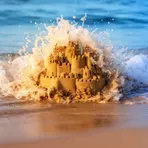
- The river washed away the sandcastles that the children had built on the beach.
- rain washes away
- heavy rain washes away
- wash away the soil
Loading YouTube…
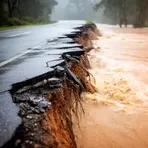
Watch on YouTubeLike this road was washed away in a flood two years ago.
- Like this road was washed away in a flood two years ago.
- We're just going to squeeze out all that excess water because all of that salt is going to wash away with it.
- It's during deep sleep when you have a cleansing system in the brain that starts washing away the toxic proteins that build up by way of wakefulness.
- If I lose, if I throw this into the the river and it washes away, I can recreate it because it's all backed up when we haven't backed up our brains.
- If a clod be washed away by the sea, Europe is the less.
- So you can't really, it's hard to process initially, you know, so you can washing away that mud every day.
- These might be just more of a wash of colour, but still, it didn't wash me, it was washing away the lip glass.
- If a cloth be washed away by the sea, Europe is the last each man's death.
Examples
-
Like this road was washed away in a flood two years ago.
-
Whole portions crumbled and washed away in the flood of her grief.
-
The road got washed away.
-
The rain washed it away.
-
All your things were washed away when you tried to cross the river.
Fiction book (1992) -
My warehouse was washed away in a flood about 10 years ago.
-
There's a huge storm coming up that will wash everything away.
-
And believe me, this flood is gonna wash away all of Apex's lies.
-
Speaker, next week marks five years since the train line at Dawlish was washed away in storms.
-
In some tropical rain forests, topsoil would be washed away if the forests were cleared for intensive agriculture.
Academic text (1990)
Synonyms
 ∞
1.5
∞
1.5
To move something or someone away from a place
 258
2.3
258
2.3
To carry away soil or rock by moving water
 168
2.7
168
2.7
To clean something by running water through it
 136
3.2
136
3.2
To remove something unwanted from a place
 83
1.0
83
1.0
To wash something with water to remove soap or dirt
 51
4.5
51
4.5
Force unwanted people or things out of a place, often using water
 31
1.0
31
1.0
To remove something from a surface by washing with water or soap
 27
4.0
27
4.0
Remove an outside layer or covering from something to show what is under it
 16
3.8
16
3.8
To get rid of something completely so it no longer exists
 12
6.6
12
6.6
To wash out dissolved material from something using water
 10
1.6
10
1.6
To wash something with water to remove soap or dirt
 10
1.8
10
1.8
To take things away from a place to make it tidy
 8
4.3
8
4.3
Carry away soil or roads by strong flowing water
Antonyms


How Strong

Surface Forms
Morphology
The verbs 'wash' (to flow over/remove) combined with 'away' (to be removed) directly yields the sense of something being removed or eliminated; this compositional relation makes the core meaning transparent. The abstract sense 'to disregard' is a natural metaphorical extension of physical removal and is cross-linguistically common, so an average B1 learner who knows the constituents would likely infer the intended meaning.
Etymology
Wash away comes from the clear image of water hitting something and carrying it away; the verb wash shows water and away shows movement from a place. That's why it means 'to remove or carry something by water'.