

to unravel
 38
4.3
38
4.3

- verb
- /ʌnˈrævəl/
- As she carefully pulled on the loose thread, the sweater began to unravel.
- begin to unravel
- come unraveled
- to unravel completely
Loading YouTube…
Watch on YouTubeSo as their case starts unraveling, they started.
- So as their case starts unraveling, they started.
- So it's no wonder that the world is unraveling as we speak.
- And heaven help us if it unravels in an ugly way, which is quite possible.
- So the system is is unraveling right now.
- And when the feud reaches a certain point, everything starts to unravel.
- Seagulls spread out in a line by the water's edge, a string of lights unraveling.
- And when we're talking about, you know, a business going under a relationship, you know, that's unraveling right now.
- Yeah, it's when we corrupt and violate the trust fabric, which is money, society unravels.
- So technically, if the knit is not that tight, if you pull one thread, it's going to come and done, but it's going to unravel, so to say.
- So all that stuff will start to unravel over time, but from that point, it could still be a long slide.
Examples
-
The very fabric of our society would begin to unravel.
-
Don't start pulling on that string or the whole fabric of our world will unravel.
-
The sector of the economy that seems likely to unravel first is food.
Academic text (2003) -
Boy gets up and begins to unravel the locks, starting at the top.
Fiction book (1998) -
So the system is is unraveling right now.
-
Because when things start to unravel, the model of masculinity is get your stuff together and figure it out.
-
I think the rope is unraveling.
-
In other words, although globalization has passed its peak, it is unlikely to unravel completely.
Academic text (2007) -
People wept, people shouted and people were really worried that the union was going to unravel and fall apart.
-
A few weeks after surgery, Noah bent down over his patient's head to unravel the bandages.
Fiction book (2002)
Synonyms
 71
7.9
71
7.9
To develop a long narrow line where knitted fabric comes undone
 66
2.7
66
2.7
Separate something into smaller pieces
 44
3.1
44
3.1
To break into pieces or fall into separate parts
 26
3.0
26
3.0
To separate into pieces, for example a machine or a group
 10
3.5
10
3.5
To separate threads or cords that are twisted together
 5
3.7
5
3.7
Make a wrapped or twisted thing loose and straight
 2
3.7
2
3.7
To make something that is twisted become straight
 1
7.0
1
7.0
To gently pull apart fibers or threads to separate them
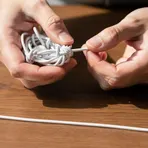 1
5.3
1
5.3
To free something twisted and knotted, like a cord
 1
6.3
1
6.3
To unwind thread or tape from a spool


 1
8.6
1
8.6
To take apart threads that form cloth or a basket
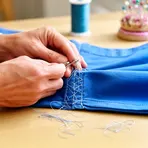 1
6.4
1
6.4
To remove stitches from fabric by taking out the thread
 1
6.3
1
6.3
To pull out the thread used to join pieces of cloth or close a cut
 1
7.4
1
7.4
To separate things that are twisted together, like cables or yarn

To undo a sweater or other item made from yarn to reuse the yarn

To untangle threads or cords that are twisted together
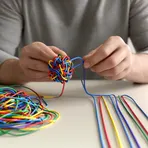
To separate twisted threads or make a confused situation clear
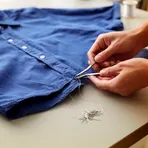
To remove stitches from cloth or clothing

To come out of a tight roll or curl
Antonyms

Idioms

How Intact
90
3.4
 37
4.2
38
4.3
155
2.8
35
5.8
37
4.2
38
4.3
155
2.8
35
5.8
Surface Forms
Morphology
Etymology
Unravel comes from the parts un- ('reverse') and ravel ('to tangle'), giving the image of pulling threads apart. So to unravel a rope or piece of cloth is to make its threads come apart or to untie its knots.