

to unravel
 75
4.4
75
4.4

- verb
- /ʌnˈrævəl/
- The detective worked tirelessly to unravel the clues behind the mysterious disappearance.
- unravel the mystery
- unravel the plot
- attempt to unravel
Loading YouTube…
Watch on YouTubeAnd this is to unravel what caused the bang.
- And this is to unravel what caused the bang.
- It's been incredibly helpful to have space to just unravel my thoughts.
- We start to unravel maybe the secrets behind her life.
- So how did scientists in a pre technology era go about trying to unravel this problem?
- Whatever the reason, it means that when the red flag show up, things may unravel fast.
- So maybe physicists will finally unravel the origin of the most mysterious of all objects.
- What mystery am I trying to unravel?
- We try to move towards unraveling that and reconciling that.
- It's like a constant unraveling experience, right?
- But don't worry, I won't spend the centuries unraveling that that story here.
- When the light is crushed, time unravels its string.
- Well, because it's going to, it's going to unravel the, you know, what we're doing with the CIA.
Examples
-
I work my mind, doing my best to unravel the mysteries.
-
Well, in the last number of years, we've begun to unravel this somewhat.
-
Now I have to unravel this bit by bit.
-
Wow, a lot to unravel here as well.
-
I spent years trying to unravel your secret, and now, suddenly, here you are.
-
And I think because of that, we're still trying to unravel history and memory in Turkey today.
-
We start to unravel maybe the secrets behind her life.
-
It's been incredibly helpful to have space to just unravel my thoughts.
-
I had investigated it long ago, seeking to unravel its secrets to save my people.
Fiction book (1991) -
As acute listeners, we can help our students and audiences unravel the wonders of music.
Academic text (1994)
Synonyms
 23
7.2
23
7.2
Examine a text or artwork to show hidden ideas and assumptions
 10
3.5
10
3.5
To separate threads or cords that are twisted together
 5
3.7
5
3.7
Make a wrapped or twisted thing loose and straight
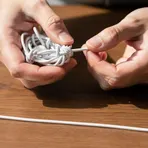 1
5.3
1
5.3
To free something twisted and knotted, like a cord


 1
7.6
1
7.6
To free something from a tangle, like knots in rope or wire
 1
7.4
1
7.4
To separate things that are twisted together, like cables or yarn
 1
8.6
1
8.6
To take apart threads that form cloth or a basket
 1
6.6
1
6.6
To study a difficult problem carefully to understand or solve it
 1
7.2
1
7.2
To find the answer to a riddle or mystery
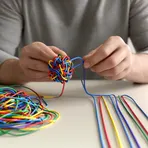
To separate twisted threads or make a confused situation clear

To untangle threads or cords that are twisted together
Antonyms


Idioms

How Clear

Surface Forms
Morphology
Etymology
Unravel comes from un- ('reverse') and ravel ('to tangle'), like pulling a tangled thread loose. So to unravel a mystery or problem is to untangle its parts and make it clear.