

to seal off
 3
3.7
3
3.7

- phrasal verb
- /siːl ɔf/
- All right, according to this, the time vehicle is sealed off in a side tunnel.
Loading YouTube…
Watch on YouTubeAll of those are sealed off containers.
- All of those are sealed off containers.
- Why, as a bargain to get whiteness, to get access, to become part of, you know that word hermetic means sealed off, right?
Examples
-
The firefighters had to seal off the entire street to contain the gas leak.
-
The grout worked as a bonding agent and sealed off the cavities between the tunnel lining and the rock surface.
Academic text (1993) -
Some police officers came by and sealed it off.
-
You sealed off the system.
Fiction book (1995) -
You can still get out through the kitchen, they haven't sealed it off yet.
-
If they had been able to build up sufficient pressure, the company had hoped to pump in cement and seal off the well.
Blog text (14) -
When you sealed off the walls, you assured us that it would only be a temporary precaution.
-
Once we seal off a few lava tubes, we'll have loads of living space.
Fiction book (2001) -
They sealed off the blood vessel that was ballooning out.
-
When the outer magnetic assembly is dismantled, the containment shell remains in the casing, where it seals off the medium handled toward the atmosphere, so drainage of the pump can be eliminated.
Academic text (2001)
Synonyms
 ∞
1.0
∞
1.0
To close something so it is not open
 ∞
1.0
∞
1.0
To shut something so it is not open
 ∞
1.0
∞
1.0
To fasten something with a key so other people cannot open it
 457
2.5
457
2.5
To close something tightly to stop air or water getting in
 97
2.6
97
2.6
Close a house or safe with a key to keep people out
 84
3.7
84
3.7
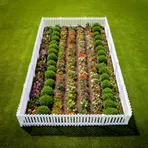
Surround something completely, often with a wall or fence
 70
3.9
70
3.9
To keep something inside so it cannot escape by closing or locking
 34
4.9
34
4.9
To cover something completely so nothing can get in or out
 24
3.9
24
3.9
Stop people or vehicles from entering a place
 20
6.3
20
6.3
Stop people entering or leaving an area by using police and barriers
 15
3.9
15
3.9
Close something tightly so air, water, or flavor cannot escape
 15
3.7
15
3.7
To bring the edges of something together so there is no gap
 11
3.4
11
3.4
To fasten something using a small metal lock with a U-shaped bar
 6
6.7
6
6.7
To fill a gap with waterproof material to stop water or air coming in
 5
8.4
5
8.4
Block an opening to stop the flow of liquid or air
 4
3.7
4
3.7
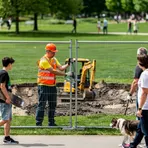
Surround an area with a fence to stop people from entering
 3
5.5
3
5.5
Keep people and things in a place where they cannot leave or be seen
 1
1.9
1
1.9
Close something tightly so nothing can get in or out

To close a bottle or jar with a small plug

To cover a joint or container with material so it does not leak

Surround something completely so it cannot get out or move

Surround something completely on all sides to shut it in
Antonyms


How Sealed

Surface Forms
Morphology
The meaning 'to make something tightly closed or secure' is directly derivable from combining 'seal' (to make airtight/watertight) with the particle 'off' (indicating closure, removal, or isolation), so the sense is compositional and predictable. This is a regular verb+particle construction common in English (and with parallels in other languages), so a B1 learner who knows both constituents would very likely infer the MWE's meaning.
Etymology
Seal off may come from the image of covering a hole with a tight seal and closing it off so nothing can get in or out. That's why it means 'to make something tightly closed' to stop leaks or dirt.