

to cordon off
 20
6.3
20
6.3

- phrasal verb
- /ˈkɔrdən ɔf/
 :
acordonar
:
acordonar
- It's worse downtown where police have cordoned off the train station and are searching all passengers.
- cordoned off area
So the natural tendency is to just sort of cordon it off.
- So the natural tendency is to just sort of cordon it off.
- Well, when Daniel Inaway's casket was laid out and cordoned off, that friend was wheeled up to the cordons around that casket.
Examples
-
Some houses were still cordoned off with yellow tape.
Fiction book (1991) -
The police have cordoned off a section of the parking lot and transformed it into a command post.
Fiction book (2002) -
The area was immediately cordoned off.
-
-We cordoned off the area.
-
The area around the scene of the murder has been cordoned off with tape.
Fiction book (1991) -
We intend to cordon off the area and make sure the situation is contained.
-
Police have cordoned off the area until it can be determined whether the unidentified object poses any threat.
Fiction book (1995) -
On election day, police cordoned off ballot stations in opposition strongholds.
Academic text (2011) -
The area was cordoned off and at first light this morning, British Army technical experts went in to examine the bodies in case they had been booby trapped.
-
The police cordoned off the area to prevent anyone from entering the crime scene.
Synonyms
 84
3.7
84
3.7
Surround something completely, often with a wall or fence
 47
3.9
47
3.9
Stop people from entering or leaving an area by blocking it
 42
4.8
42
4.8
To stop people from entering a place by putting up a barrier
 24
3.9
24
3.9
Stop people or vehicles from entering a place
 24
5.8
24
5.8
To block off an area with people or barriers to keep people away
 23
3.8
23
3.8
Close a road, path or entrance so people cannot go through
 11
4.0
11
4.0
Prevent someone or somewhere from having contact with others
 9
6.0
9
6.0
To stop people and goods entering or leaving a place, often during war
 4
3.7
4
3.7
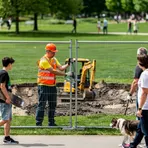
Surround an area with a fence to stop people from entering
 3
4.8
3
4.8
To keep people out of an area by putting ropes around it
 3
3.0
3
3.0
To surround an area with a barrier to keep others out
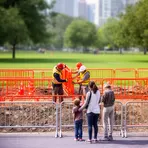
To separate people or part of a place by putting up a barrier
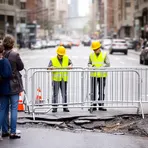
To block a place so people cannot enter, often by putting up a fence

Surround something completely so it cannot get out or move

To make part of a room private by closing a curtain
Antonyms

How Enclosed


Surface Forms
Morphology
The noun 'cordon' (a line of officers or guards enclosing an area) combined with the particle 'off' (marking separation or exclusion) yields a directly compositional meaning: to mark or enclose an area to prevent access. This verb+particle pattern is transparent and follows common cross-linguistic logic, so a B1 learner who knows the constituents should be able to infer the MWE's meaning.
Etymology
Cordon off The phrasal verb cordon off comes from the image of a cordon, a rope or ribbon, placed off around a scene to keep people out. So, to cordon off somewhere means 'to prevent people from entering or leaving' by making a line or barrier.