

to get off
 213
1.6
213
1.6

- phrasal verb
- /ɡɛt ɔf/
- After a long ride, we got off the plane and headed straight for customs.
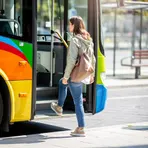
- get off the bus
Loading YouTube…
Watch on YouTubeAnd so they're at this point, they're getting off the bus in the compound now.
- And so they're at this point, they're getting off the bus in the compound now.
- I said when I got off the plane, it looked like the safari.
- He left, left, literally got off the plane.
- Do you get off the bus and miss the boat or get off the boat and miss the bus?
- They would ride places, then they'd get off and fight, you know, on their feet as infantry.
- I came home and as soon as I got off the car I fainted.
- Anyways, God, I sound especially get off my lawn today, don't I?
- This one get off my lawn.
- He got off the train the wrong side strain come round and killed him.
Examples
-
I took the bus every morning and got off at my friend Mary Tyler's stop.
Fiction book (1990) -
When the train finally arrived, the passengers eagerly got off to start their vacation.
-
Do you get off the bus and miss the boat or get off the boat and miss the bus?
-
Yeah, we used to get off the stage and go in the back of the bus.
-
Three young men and a woman get off at the same stop.
Academic text (2011) -
We are in the Philippines, so we just got off the plane.
-
Schools advise remaining school bus users to get off at the previous stop and walk home from there.
Academic text (2012) -
The old man got off the early train and stood on the platform surveying the town.
Fiction book (1993) -
And so they're at this point, they're getting off the bus in the compound now.
-
At the Grand Central stop, I switched to the Lexington Avenue express and got off at Eighty-sixth.
Fiction book (1994)
Synonyms
 ∞
1.0
∞
1.0
To go away from a place, person, or group
 ∞
1.0
∞
1.0
Leave a place or situation
 ∞
3.0
∞
3.0
Leave a place quickly or suddenly
 709
1.0
709
1.0
To leave a place or person and go somewhere else
 632
3.5
632
3.5
Leave a person, place, or situation without taking part anymore
 356
2.8
356
2.8
Move away from someone, or stop taking part in something
 321
8.1
321
8.1
Tell someone to stop doing something annoying
 273
3.2
273
3.2
To leave a place quickly, often to travel somewhere else
 206
3.4
206
3.4
To stop being involved in an activity or agreement
 125
1.0
125
1.0
To go out of a place or leave a situation
 104
4.1
104
4.1
Stop doing something for a short time, for example at a point in a book
 102
3.4
102
3.4
Stop doing something that annoys someone
 37
3.5
37
3.5
To leave a place suddenly to show you are angry or upset
 37
8.1
37
8.1
Tell someone to leave in a rude way
 32
1.9
32
1.9
Leave a vehicle like a bus or train at a stop
 24
3.9
24
3.9
To leave a place by riding a horse, bike, or motorcycle
 21
5.1
21
5.1
To leave a ship, plane, or other vehicle after a journey
 21
4.5
21
4.5
To get off a horse, bicycle, or vehicle
 19
6.4
19
6.4
To run away quickly after stealing or committing a crime
 14
6.8
14
6.8
Leave a place or start a journey
 12
8.4
12
8.4
To tell someone to go away right away in a rude or angry way
 12
7.7
12
7.7
Leave a place quickly, often in a rude way
 10
4.9
10
4.9
Leave a person because they are angry with you
 6
3.1
6
3.1
Get off a bus or leave a call quickly
 4
8.9
4
8.9
Tell someone to go away and leave you alone
 3
4.1
3
4.1
To leave a group and move away in a different direction
 3
9.9
3
9.9
Tell someone to go away in a rude way


 1
7.9
1
7.9
To leave a place quickly, often without saying goodbye

To leave a place suddenly, usually to go somewhere else

To leave quickly and quietly or tell someone rudely to go away
Antonyms


Surface Forms
Morphology
get + off
The sense 'leave a vehicle' is directly derivable from combining a motion verb 'get' (move/arrive at) with the particle 'off' (away from a surface), so that reading is transparent to learners. However, the extension 'stop bothering/irritating someone' is a metaphorical use of 'off' (move away from/contact removed) and requires recognition of a figurative transfer, so overall the item is only partially predictable.
Etymology
Get off for leaving a vehicle or telling someone to stop comes from the same image of moving away or stepping off something or someone. So it can mean both 'to leave a bus or train' and 'to stop bothering someone'.