

to make off
 19
6.4
19
6.4

- phrasal verb
- /meɪk ɔf/
- The cashier of a factory in Ledbury Street... ...was attacked in his office... ...and two men made off with several hundred pounds... ...mostly in pound notes.
Examples
-
...was robbed by three masked gunmen, who made off with over $50,000 in cash.
-
According to the casino, the crew made off with close to $1.2 million.
-
I lied and got through it and made off with the books.
Fiction book (2002) -
He must have made off with it.
-
The frightened guards watch as Phil makes off with two large satchels of cash.
Fiction book (1993) -
Smith suggests considering the extent of financial damage and the likelihood that the attackers made off with confidential data.
Academic text (2002) -
- Three armed men wearing ski masks made off with over $20,000 from an area bank in a daring early morning robbery.
-
Couple of whacked-out wrestlers doublecrossed me and made off with a very valuable briefcase.
-
Before Lulu's bordello was demolished in 1949, jazz aficionados made off with anything they could carry, from furnishings to wallpaper.
Academic text (2002) -
The thieves made off with priceless paintings from the museum after closing hours.
Synonyms
 ∞
1.0
∞
1.0
To not take something or someone with you when you go
 786
4.1
786
4.1
To avoid being punished for something you did wrong
 709
1.0
709
1.0
To leave a place or person and go somewhere else
 550
1.6
550
1.6
To leave secretly and quickly to get away from danger or control
 273
3.2
273
3.2
To leave a place quickly, often to travel somewhere else
 260
3.7
260
3.7
To leave a place or person suddenly, often without saying goodbye
 247
7.1
247
7.1
Leave suddenly to avoid a responsibility or task
 78
2.0
78
2.0
Leave a place suddenly, often to avoid someone or something
 69
2.3
69
2.3
To run away suddenly to escape danger
 50
5.4
50
5.4
To leave quickly with something stolen or taken without permission
 33
4.0
33
4.0
Leave a place quietly so others do not notice
 20
3.8
20
3.8
Leave suddenly because you are in a hurry
 14
6.8
14
6.8
Leave a place or start a journey
 13
6.5
13
6.5
To take something quickly without the owner's permission, often without being noticed
 12
7.7
12
7.7
Leave a place quickly, often in a rude way
 11
8.5
11
8.5
To leave quickly and secretly with money or things to avoid being caught
 11
4.4
11
4.4
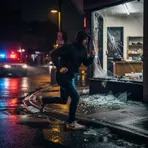
Leave a place quickly to avoid being caught after causing or seeing trouble
 7
9.2
7
9.2
Leave a place quickly to avoid trouble or danger
 6
7.5
6
7.5
To take something that is not yours and carry it away without asking
 5
4.9
5
4.9
Leave a place suddenly and quickly because you feel scared
 5
6.6
5
6.6
Leave a place quickly because people are angry or you are in trouble
 5
7.2
5
7.2
Leave quickly to go somewhere or to avoid trouble
 4
8.5
4
8.5
To leave a place quickly and secretly to avoid being caught
 3
4.1
3
4.1
To leave a group and move away in a different direction
 2
2.5
2
2.5
Leave a place quickly because you are in a hurry
 1
9.9
1
9.9
Leave a place very quickly


 1
7.9
1
7.9
To leave a place quickly, often without saying goodbye

To leave a place quickly and secretly, often taking things or someone

To run away quickly, usually because you are afraid

Leave a place quickly because you are not welcome

To leave a place suddenly, usually to go somewhere else
Antonyms


How Fast
- Formal
11
8.5
 331
2.4
34
2.9
19
6.4
32
3.4
632
3.5
331
2.4
34
2.9
19
6.4
32
3.4
632
3.5
Surface Forms
Morphology
The particle 'off' carries a clear 'away'/departure sense, so a learner who knows 'make' and 'off' could plausibly infer a sense of leaving; however, the specific meaning 'leave quickly' and the conventional association with fleeing after a crime are conventionalized aspects of the phrasal verb that are not fully predictable from the parts. Because the directional component is transparent but the rapid/illicit nuance is idiomatic, this is best classified as partially transparent.
Etymology
Make off comes from a clear picture: someone makes a quick move and goes off, running away from the place often after taking something. That's why it now means 'to leave quickly', especially after a crime.