
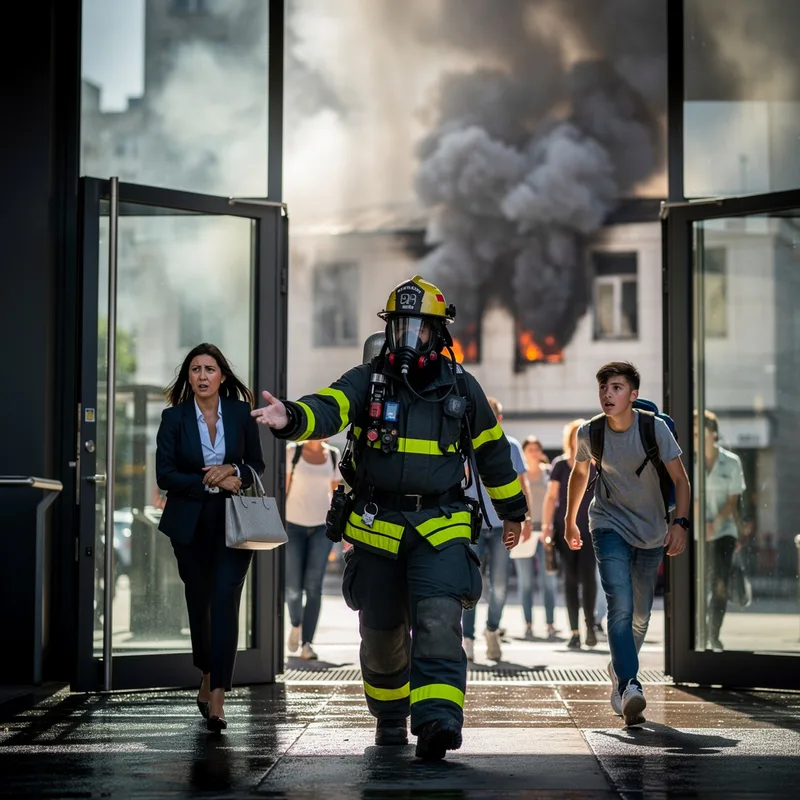
to evacuate
 344
4.1
344
4.1

- verb
- /ɪˈvæk.ju.eɪt/
- Evacuate the area.
- evacuate homes
- evacuate people
- evacuate the area
Loading YouTube…
Watch on YouTubeOK, but remember, they can barely evacuate people from LaGuardia.
- OK, but remember, they can barely evacuate people from LaGuardia.
- But Father, he's now Mark was able to effectively evacuate this gentleman.
- Obviously made a sound and he left the building expecting everyone to evacuate.
- And so the authorities decide that all the children in the cities across the UK need to be evacuated.
- When I started working on the frontline in Zaparisha, we would evacuate casualties to that actual hospital that I used to work at.
- So that was the and you guys evacuated how many people?
- We were able to secure a plane that flew in with humanitarian supplies to Puerto Rico and then evacuated our sixty dogs four days after the hurricane.
- On top of that, a lot of people that decided, oh, shit, this is a little worse than we thought and tried to evacuate at last minute, drowned in their cars.
Examples
-
There was also no difficulty evacuating casualties from the front lines to medical centers within Israel.
Academic text (2015) -
More than 20 families had to be evacuated while their homes were decontaminated.
Academic text (1997) -
And then they told me to evacuate the house, get far away.
-
We have to evacuate the building and close it down.
-
By the time they tried to evacuate the cities, it was already too late.
Academic text (2012) -
We've had to evacuate all personnel from the island for their own safety.
-
The building's being evacuated.
-
We're reporting live from Dante's Peak, where they're evacuating the entire town.
-
In 2004, two NGOs working near Malakal were evacuated owing to mounting insecurity.
Academic text (2004) -
Everyone needs to evacuate the area immediately due to the approaching storm.
Synonyms
 ∞
1.0
∞
1.0
Leave a place or situation
 ∞
3.0
∞
3.0
Leave a place quickly or suddenly
 ∞
1.0
∞
1.0
To get away from a place where you are kept or are in danger
 ∞
1.0
∞
1.0
Leave a place to do a task, for example to help people
 709
1.0
709
1.0
To leave a place or person and go somewhere else
 550
1.6
550
1.6
To leave secretly and quickly to get away from danger or control
 331
2.4
331
2.4
To run away from a place because it is dangerous
 273
3.2
273
3.2
To leave a place quickly, often to travel somewhere else
 235
4.0
235
4.0
To move back from a place or plan to avoid danger
 125
1.0
125
1.0
To go out of a place or leave a situation
 26
3.6
26
3.6
Move out of a place suddenly in large numbers or fall out of a container and spread
 13
4.4
13
4.4
To move back from a place or activity to avoid danger and trouble
 12
7.9
12
7.9
To leave a place suddenly without permission
 11
3.5
11
3.5
Leave quickly to escape danger, often by flying
 11
3.4
11
3.4
To move people out of a building for safety during an emergency
 6
4.1
6
4.1
Leave a place because it is dangerous or officials tell you to
 5
4.9
5
4.9
Leave a place suddenly and quickly because you feel scared
 5
6.6
5
6.6
Leave a place quickly because people are angry or you are in trouble
Antonyms

Phrasal Verbs
How Quickly

Surface Forms
Morphology
Etymology
Evacuate comes from the Latin parts e- ('out') and vac- ('empty'), the same root you see in vacant and vacuum. So to evacuate people is to move them 'out' until the place is empty for safety.