

to fence off
 4
3.7
4
3.7

- phrasal verb
- /fɛns ɔf/
- To protect the crops from deer, the farmer will fence off the field.
- fence off land
Examples
-
Elsewhere, wildebeest populations have crashed because people have encroached on their ranges, often fencing off vital migration routes.
Academic text (2006) -
Most petitioners were farmers requesting permission to fence off roads that were in poor condition, infrequently used, and to defragment their farmland.
Academic text (2004) -
A ticket to the event provided access to the fenced-off main festival area.
Blog text (26) -
The library and school were located outside the yard, on a restricted and fenced-off section of the camp.
Fiction book (1994) -
Soon, this will all be fenced off behind a chain-link wall.
Blog text (12) -
The two horses were out in a field the old man had fenced off with brush and brambles.
Fiction book (1997) -
Surveyors and hardhats bustle about in a vacant lot, a full city block in size, fenced off and strewn with rubble.
Fiction book (1992) -
The southeast end was fenced off for a hay field; pyramids of curing hay dotted the pale stubble.
Fiction book (1990) -
The city decided to fence off the park to keep people safe during construction.
-
After the incident, they quickly fence off the area to prevent further access.
Synonyms
 84
3.7
84
3.7
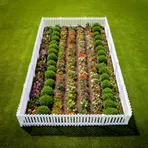
Surround something completely, often with a wall or fence
 47
3.9
47
3.9
Stop people from entering or leaving an area by blocking it
 42
4.8
42
4.8
To stop people from entering a place by putting up a barrier
 41
6.4
41
6.4
To surround an area with a wall to protect it
 24
3.9
24
3.9
Stop people or vehicles from entering a place
 23
3.8
23
3.8
Close a road, path or entrance so people cannot go through
 20
6.3
20
6.3
Stop people entering or leaving an area by using police and barriers
 19
2.4
19
2.4
To put a barrier around land to mark or protect it
 9
6.0
9
6.0
To stop people and goods entering or leaving a place, often during war
 7
5.8
7
5.8
To build a barrier around something to keep people in or keep others out
 7
1.8
7
1.8
To make a barrier of wood, metal, or wire around land to keep animals and people out
 3
3.0
3
3.0
To surround an area with a barrier to keep others out
 3
4.8
3
4.8
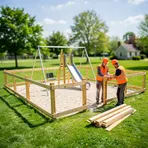
To keep people out of an area by putting ropes around it
 1
5.7
1
5.7
To enclose an area by putting up rails

To surround a place with rails or a fence for protection
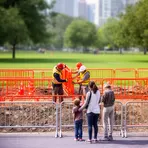
To separate people or part of a place by putting up a barrier

To divide a space with a wall or curtain to make a new area

Surround a place or person so they cannot move freely
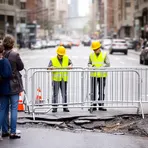
To block a place so people cannot enter, often by putting up a fence
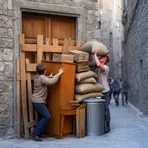
To block a place with things to stop people from entering

To make part of a room private by closing a curtain
Antonyms

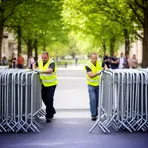


How Enclosed

Surface Forms
Morphology
The meaning 'to enclose an area by putting up a fence' is directly derivable from combining 'fence' (to erect a barrier) with the particle 'off' (indicating separation or exclusion), so a B1 learner who knows both constituents can infer the sense. The verb+off phrasal pattern commonly signals preventing access or separating something in English and other languages, making this construction transparently compositional.
Etymology
Fence off comes from the simple image of putting up a fence to shut an area off from the rest and keep people or animals away. So, fence off means 'to enclose an area' or 'to prevent access'.