

to rail in
- phrasal verb
- /reɪl ɪn/
- The cemetery is railed in to prevent animals from entering.
Examples
-
They decided to rail in the playground for the children's safety.
-
They railed in the new playground.
-
He railed in his vegetable garden to keep out rabbits.
-
Can you rail in the garden area?
-
The garden was beautifully railed in to keep the rabbits out.
-
To enhance safety, they railed in the swimming pool with a secure fence.
-
The children played in the area that was railed in with colorful wooden barriers.
Synonyms
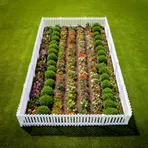
 84
3.7
84
3.7

Surround something completely, often with a wall or fence
 41
6.4
41
6.4
To surround an area with a wall to protect it
 19
2.4
19
2.4
To put a barrier around land to mark or protect it
 7
5.8
7
5.8
To build a barrier around something to keep people in or keep others out
 4
3.7
4
3.7
Surround an area with a fence to stop people from entering
 3
3.0
3
3.0
To surround an area with a barrier to keep others out
 1
5.7
1
5.7
To enclose an area by putting up rails
To separate people or part of a place by putting up a barrier
Antonyms



How Enclosed

Surface Forms
Morphology
The meaning 'to enclose or surround with rails' is directly derivable from combining the verb 'rail' (to fence off/enclose) with the preposition 'in' (indicating inside or within boundaries). This is a transparent, compositional verb+particle construction following common English patterns, so a B1 learner who knows both constituents should understand the MWE.
Etymology
Rail in comes from the simple picture of putting rails around a place so it is kept in. So, to rail in something today means 'to enclose' it or 'to fence it in'.