

to disjoin
 1
7.4
1
7.4

- verb
- /dɪsˈdʒɔɪn/
- One nontrivial criterion for judging a proper artwork can be found in the principle of "organic unity." As Aristotle once defined it, an organic unity exists when the parts of a whole are "so closely connected that the transposition or withdrawal of any one of them will disjoin and dislocate the whole."
Examples
-
Then I disjoin the machine from the domain, Sysprep it with my unattend.xml file, and capture an image to my WDS server.
Blog text (19) -
So there is this disjoining pressure that people sometimes use.
-
"The God who gave us life gave us liberty at the same time; the hand of force may destroy, but cannot disjoin them."
Blog text (22) -
By "socialism," I mean a society unmistakably disjoined from capitalism, which is to say, disconnected from the very idea of economic determinism.
Academic text (1992) -
The technician had to disjoin the two cables to fix the connection issue.
-
When the team decided to disjoin their efforts, they realized they could work more effectively on their own.
-
It is important to disjoin the pieces before washing the toys to prevent damage.
Synonyms
 575
2.3
575
2.3
End a relationship or go separate ways
 297
1.9
297
1.9
To break into parts or pieces
 241
2.9
241
2.9
To separate and move in different directions after being together
 219
2.7
219
2.7
To keep one thing apart from another so they do not mix
 161
3.5
161
3.5
To separate something so it is no longer joined, for example remove a cable or turn off power
 82
5.3
82
5.3
To stop being part of or connected to something
 64
4.2
64
4.2
Take something apart into separate pieces
 28
2.8
28
2.8
To make a piece come away from something by hitting or bending it
 16
4.0
16
4.0
To come apart from something it is connected to
 5
5.3
5
5.3
To disconnect two things that are joined, often machine parts
 4
6.7
4
6.7
Disconnect parts that were joined so they work independently
 1
9.8
1
9.8
Take bones or meat apart at the joints
 1
7.0
1
7.0
To cause people or groups to separate
 1
5.3
1
5.3
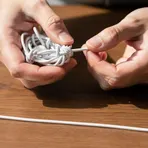
To free something twisted and knotted, like a cord
 1
9.9
1
9.9
To cut or separate something into parts, often by breaking it
 1
6.6
1
6.6
To release something that is tied or fastened so it can move away
 1
6.1
1
6.1
To separate something from what it is connected to


 1
7.0
1
7.0
To separate parts so they are no longer connected
 1
8.0
1
8.0
To separate a company into independent businesses
 1
7.4
1
7.4
To separate things that are twisted together, like cables or yarn

To divide something into separate parts

To untangle threads or cords that are twisted together

To divide a space with a wall or curtain to make a new area
Antonyms

How Joined
88
1.0
 16
3.9
829
2.1
1
7.4
241
2.9
50
3.0
16
3.9
829
2.1
1
7.4
241
2.9
50
3.0
Surface Forms
Morphology
Etymology
Disjoin comes from the prefix dis- meaning 'apart' and the word join meaning 'to connect'. So, to disjoin is to take things 'apart' that were joined, which is why it means to separate or disconnect things.