

to run off
 7
2.9
7
2.9

- phrasal verb
- /rʌn ɔf/
- Rainfall ran off the roof, down new aluminum gutters, and into a several-hundred-gallon tank.
- water runs off
- run off agricultural land
Loading YouTube…
Watch on YouTubeBut there's the ink hasn't run off and the rubber hasn't melted.
- But there's the ink hasn't run off and the rubber hasn't melted.
- It may rain a lot, but the the, the, the way the rain runs off, there's not enough water for the people that live in the Highlands of those islands.
- Streams, rivers full of these chemicals run off of, we're losing quality of our soil.
- But those devices work by pushing an inked pen around on paper, and during the peak of the storm, that pen just ran off the page.
Examples
-
In the worst case, fifty percent of fertilizer or manure can run off the land.
Academic text (2000) -
Much of the nitrogen that leaches from or runs off agricultural land comes from excessive use of manure.
Academic text (2000) -
You could spill whatever on this and it just runs off the page.
-
All the trapped oil ran off into the grass.
Fiction book (2002) -
This runs off, gets into the ocean and fertilizes the ocean.
-
Overhead irrigation leaves water on the soil surface, where it can evaporate or run off before it can reach the roots.
Academic text (2005) -
During storms, rainwater runs off the pavement, collecting pollutants as it goes.
Academic text (2007) -
During the rains, water runs off the slope quickly, swelling the rivers temporarily into impassable torrents.
Academic text (1993) -
After a heavy rain, the water will run off the pavement and into the drainage system.
-
The melted snow will run off the mountain and flow into the river below.
Synonyms
 198
1.0
198
1.0
To let liquid flow away from something
 33
2.1
33
2.1
Water or another liquid carries something away
 31
2.5
31
2.5
To flow down a surface like water on a window
 16
2.9
16
2.9
Move or pour out in a steady stream, often a liquid
 4
3.3
4
3.3
To move along with a strong flow of water
 1
5.6
1
5.6
To move back slowly, like water leaving a shore
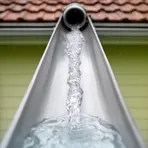 1
3.2
1
3.2
Water moves away slowly in a steady stream
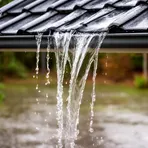
To move away from a surface in a steady stream, like water does
Antonyms


How Fast

Surface Forms
Morphology
The printing sense is tangentially related to 'run' (as in operating a machine or producing copies) but the particle 'off' does not transparently contribute the specific meaning of 'make copies'. A B1 learner who knows 'run' and 'off' might guess an action involving a machine from context but would not reliably derive the specialized photocopying sense, so this is partially compositional but not fully predictable.
Etymology
Run off for liquids paints the picture of water running and going off a roof into the street or gutter. That's why it means 'to flow away' or be lost as waste.