

to run off
 25
4.7
25
4.7

- phrasal verb
- /rʌn ɔf/
- The angry dog ran off the intruders by barking loudly.
- run off any dog
Examples
-
"It's this way!" she called, and ran off with long leaping strides toward two red, house-sized rocks.
Fiction book (1999) -
Early the next day, Jewish boys ran off to Weimar to steal clothing and potatoes.
Academic text (2016) -
I ran off the last dead beat.
-
We watched as they ran off toward the spot where the bodies were discovered.
Fiction book (1998) -
I tried to chase him but he ran off into the fog.
-
By running off Freddy's group, their enemies have claimed a small victory.
-
Some developer bought up all this... ...now our local police are running off the undesirables.
-
Another fifty or so workers ran off and eluded capture.
Academic text (2003) -
We don't have the resources to go chasing every kid who runs off with his pals.
-
Dodging into the bushes, he ran off and scrambled up a tree.
Academic text (2002)
Synonyms
 87
4.0
87
4.0
Force someone or something to leave using threats
 71
3.4
71
3.4
To force a person, animal, or feeling to go away
 70
3.8
70
3.8
Force someone or something to leave a place
 26
2.6
26
2.6
To make people or things leave by scaring them
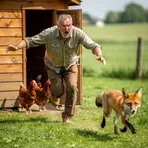 6
3.3
6
3.3
Make someone or something leave a place by running after and frightening them
Antonyms


How Forceful
107
6.3
 77
4.6
194
5.0
25
4.7
26
2.6
77
4.6
194
5.0
25
4.7
26
2.6
- Informal
35
7.0
Surface Forms
Morphology
The printing sense is tangentially related to 'run' (as in operating a machine or producing copies) but the particle 'off' does not transparently contribute the specific meaning of 'make copies'. A B1 learner who knows 'run' and 'off' might guess an action involving a machine from context but would not reliably derive the specialized photocopying sense, so this is partially compositional but not fully predictable.
Etymology
Run off can come from the image of a person chasing others away, where run is the action and off shows they go away, like a farmer who runs dogs off his field. That's why it means 'to drive away' or force someone to leave.