

particle
 447
4.2
447
4.2

- noun
- /ˈpɑrtɪkəl/
- Specialized
- One idea is that these particles make up dark matter.
- subatomic particle
- particle physics
- charged particle
Loading YouTube…
Watch on YouTubeBut I could have a single particle inside a box.
- But I could have a single particle inside a box.
- Maybe it's small particles for example, or a gas.
- You can, for example, measure where a particle is, but not when it is.
- They both exhibit particle and wave kind of behaviours.
- And in fact, they're basically act like free particles when they're very close.
- That there can be situations of a material particle, an electron, OK?
- What this tells you is that even single particles act like waves.
- The disadvantage is that the fast moving particles need to be charged.
- The origin of LDL particles is in the liver.
- But each kind of particle or object gets its own charge.
- We surely think of particles as following definite paths.
Examples
-
The origin of LDL particles is in the liver.
-
A camera captures the position of particles at the time of each flash.
Academic text (2008) -
But I could have a single particle inside a box.
-
We're asking how does the particle move in the field.
-
You can, for example, measure where a particle is, but not when it is.
-
The force on a charged particle is V cross B.
-
What this tells you is that even single particles act like waves.
-
Is light made up of particles or waves?
-
Visual scan reveals minute particles of matter adhering to the hull.
-
In physics, a particle is often considered to be a fundamental constituent of matter.
Synonyms
 ∞
1.0
∞
1.0
A small piece or amount of something, for example food
 66
1.3
66
1.3
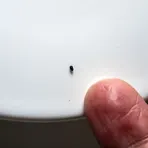
A very small spot or amount of something
 20
3.7
20
3.7
A very small amount used to talk about qualities or feelings
 14
2.8
14
2.8
A very small amount of something, almost none
 11
3.1
11
3.1
A very small amount of something that shows there is almost none
 4
8.2
4
8.2
A very small speck of dust or dirt
 1
9.4
1
9.4
A very small piece of a substance like a speck of dust

A tiny speck of dust or dirt
A very small part of matter like a tiny particle
Antonyms

Compounds
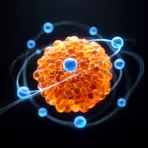
- Specialized
12
5.1
A very small part of matter smaller than an atom, like a proton or electron
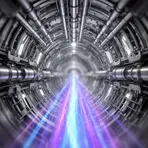
- Specialized
11
5.5
A machine that makes tiny charged particles move faster for science or medicine

- Specialized
8
4.5
The science that studies very small parts of matter and how they interact

- Specialized
7
6.8
A narrow, focused stream of tiny particles like electrons used in science and medicine
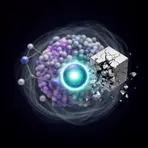
- Specialized
3
6.5
A very small part of matter that you cannot break into smaller pieces, like an electron or quark
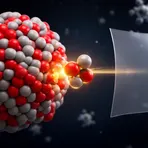
- Specialized
2
5.8
A small positively charged part of an atom with two protons and two neutrons released in radioactive decay
 2
3.5
2
3.5
A board made from small wood pieces glued and pressed for furniture and building

- Specialized
1
6.4
A fast, tiny particle like an electron that a radioactive atom gives off
- Specialized
1
6.8
A very small part of matter not made of smaller parts like an electron or quark

- Specialized
1
5.8
A machine that finds and shows very small particles inside atoms in physics experiments
- Specialized

 1
9.6
1
9.6
A physics idea that light and matter act like waves and particles when you look at them
- Specialized
A neutral particle made of three quarks that appears in particle physics
- Specialized
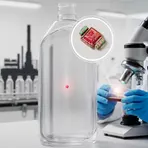
A tiny piece of matter as heavy as or heavier than a proton that feels the strong force
- Specialized
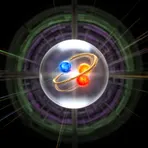
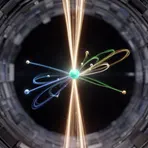
A very small particle added to a product to show where it came from
- Specialized
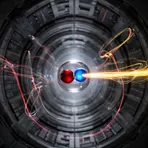
A tiny particle smaller than an atom that breaks into other particles after high-energy collisions
- Specialized
A heavy neutral meson made of a quark and an antiquark seen in physics experiments
- Specialized
A heavy, short-lived tiny part of matter like an electron but much heavier

- Specialized
A tiny particle with a positive charge like an electron but much heavier

- Specialized
Very small bits of dirty matter in the air that come from smoke and engines and can harm people's health

- Specialized
A very small particle that forms in fast collisions and decays more slowly

- Specialized
A heavy particle that hardly interacts with normal matter and may make up dark matter in space
How Small

Surface Forms
Morphology
Etymology
Particle comes from the Latin particula, a little form of part, which means 'small part'. So a particle is literally a tiny 'part' or piece of something, which fits the meaning of a very small amount.