

particle
 5
6.2
5
6.2

- noun
- /ˈpɑrtɪkəl/
- Specialized
- In phrasal verbs like 'give up' or 'put off', the words 'up' and 'off' act as particles that change the meaning of the verbs.
- preposition and particle
- omitted the particle
Examples
-
But any man with a particle of sense can see he is exactly like a rope.
Academic text (2013) -
In the sentence 'He picked up the book and put it back on the shelf', the word 'back' is an example of an adverbial particle that modifies the verb.
-
The idea was to have users freely explore the topics of particle physics.
Academic text (2006) -
Back is an adverbial particle, so that gets more stressed.
-
The children produced few substitution errors on either particles or prepositions.
Academic text (2012) -
Colleagues gather to discuss high-energy nuclear and particle physics at a 1955 conference in Rochester, New York.
Academic text (2005) -
When studying English phrasal verbs, it is important to understand how particles like 'out' and 'in' affect the verbs they accompany.
Compounds
- Specialized
12
5.1
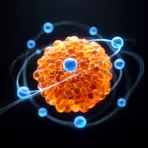
A very small part of matter smaller than an atom, like a proton or electron
- Specialized
11
5.5
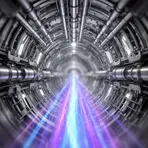
A machine that makes tiny charged particles move faster for science or medicine

- Specialized
8
4.5
The science that studies very small parts of matter and how they interact

- Specialized
7
6.8
A narrow, focused stream of tiny particles like electrons used in science and medicine
- Specialized
3
6.5
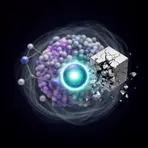
A very small part of matter that you cannot break into smaller pieces, like an electron or quark
- Specialized
2
5.8
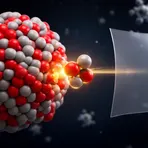
A small positively charged part of an atom with two protons and two neutrons released in radioactive decay
 2
3.5
2
3.5
A board made from small wood pieces glued and pressed for furniture and building

- Specialized
1
6.4
A fast, tiny particle like an electron that a radioactive atom gives off
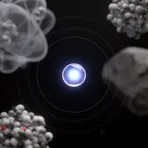
- Specialized
1
6.8
A very small part of matter not made of smaller parts like an electron or quark

- Specialized
1
5.8
A machine that finds and shows very small particles inside atoms in physics experiments
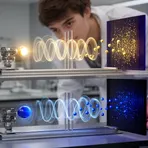
- Specialized

 1
9.6
1
9.6
A physics idea that light and matter act like waves and particles when you look at them
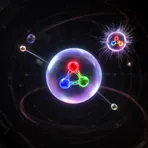
- Specialized
A neutral particle made of three quarks that appears in particle physics
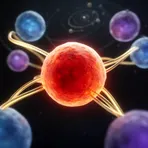
- Specialized
A tiny piece of matter as heavy as or heavier than a proton that feels the strong force
- Specialized
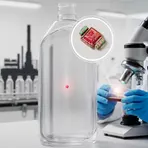
A very small particle added to a product to show where it came from
- Specialized
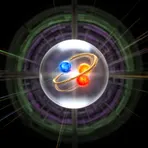
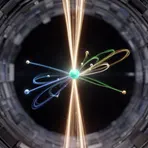
A tiny particle smaller than an atom that breaks into other particles after high-energy collisions
- Specialized
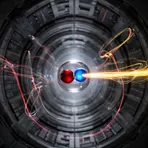
A heavy neutral meson made of a quark and an antiquark seen in physics experiments
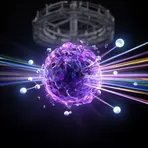
- Specialized
A heavy, short-lived tiny part of matter like an electron but much heavier

- Specialized
A tiny particle with a positive charge like an electron but much heavier

- Specialized
Very small bits of dirty matter in the air that come from smoke and engines and can harm people's health

- Specialized
A very small particle that forms in fast collisions and decays more slowly

- Specialized
A heavy particle that hardly interacts with normal matter and may make up dark matter in space
How Lexical
- Specialized

- Specialized
1
2.9
- Specialized
5
6.2
- Specialized
Surface Forms
Morphology
Etymology
Particle comes from the Latin particula, meaning 'small part', and it shares the same root as the word part. In grammar a particle is a very small 'part' of a sentence (like 'up' in 'give up') that helps change the verb's meaning.