
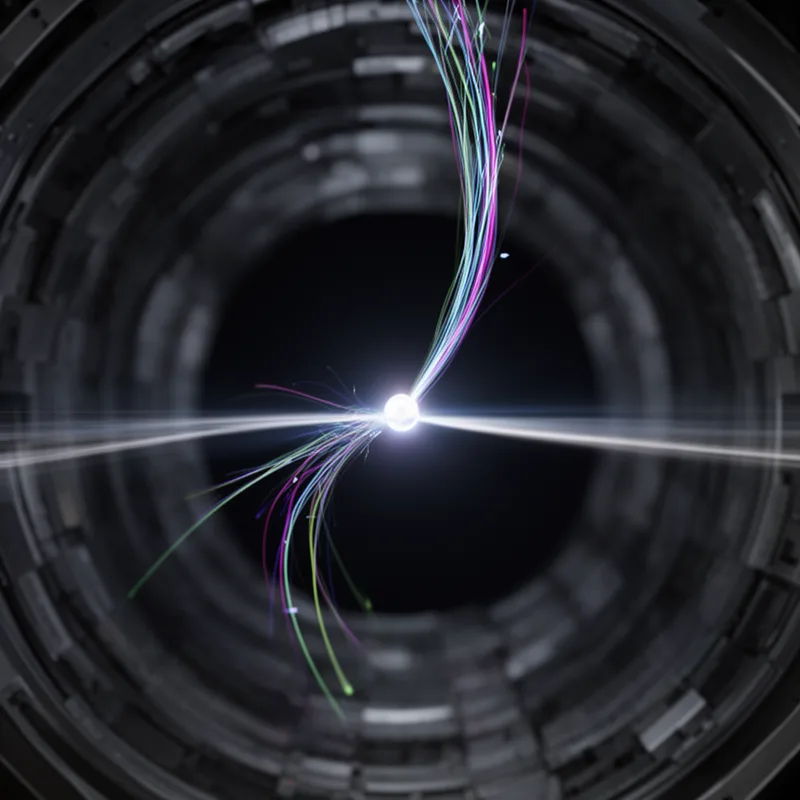
strange particle
- noun
- Specialized
- Scientists observed a strange particle in the collider.
Examples
-
Physicists observed a strange particle during the collision experiment at the accelerator.
-
A strange particle decays more slowly than an ordinary particle because of its strangeness.
-
The discovery of the first strange particle helped physicists understand the strong interaction.
-
The strange particle was discovered during the experiment.
-
The physicists observed a strange particle during their experiment at the collider.
-
Researchers are studying strange particles to understand the forces that govern their behavior.
-
During the high-energy collision, they detected a strange particle that exhibited unexpected properties.
Surface Forms
Morphology
strange + particle
A B1 learner who knows 'strange' (odd/unusual) and 'particle' (a tiny physical piece) would plausibly infer 'an unusual/special particle', so there is a visible connection to the constituents. However, the actual meaning refers to a specific technical property (non-zero strangeness in particle physics) that cannot be derived from everyday senses of the words, making the term only partially predictable without domain knowledge.
Etymology
Strange particle comes from early experiments when tiny particles were made easily but then behaved oddly and lasted longer than expected. Because of that odd behaviour, scientists called them strange, so today strange particle means a particle with the special 'strangeness' property that makes it act differently.

