
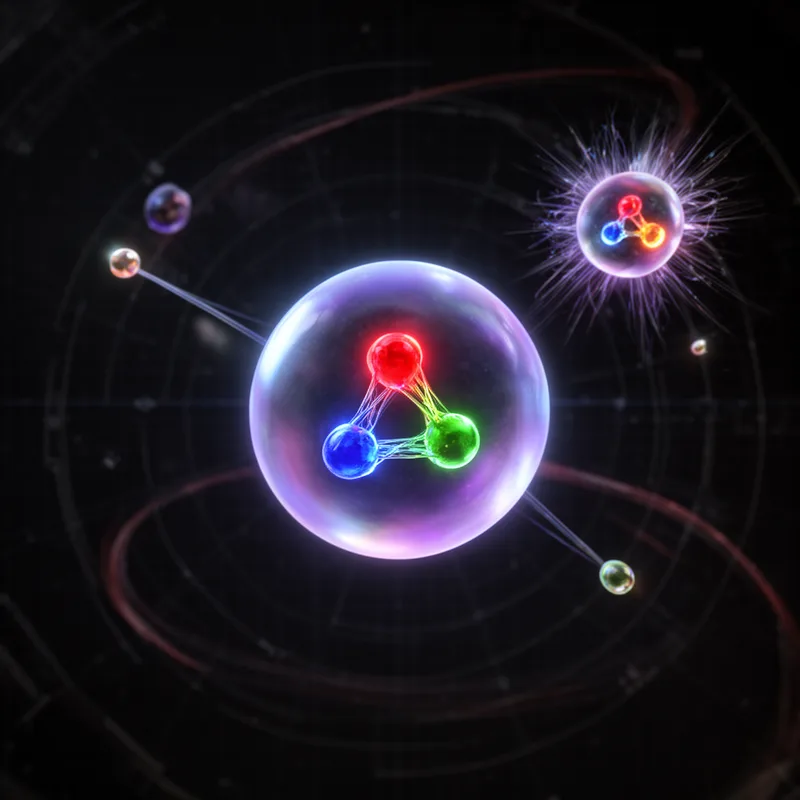
lambda particle
- noun
- /ˈlæmbdə ˈpɑrtɪkl/
- Specialized
- The decay of a lambda particle results in the production of a proton and a pion.
Examples
-
A lambda particle is neutral, distinguishing it from other baryons like the proton.
-
Physicists first observed the lambda particle in cosmic rays during the 1950s.
-
The lambda particle is a key component in particle physics.
-
Researchers discovered the lambda particle in the 1950s.
-
The decay of a lambda particle produces a proton and a pion, showcasing its unique properties in particle interactions.
-
Physicists first identified the lambda particle in cosmic rays, marking a significant discovery in particle physics.
-
A lambda particle is a neutral baryon, which sets it apart from charged baryons like protons and neutrons.
Synonyms
A tiny neutral particle made of three quarks that contains a strange quark
Surface Forms
Morphology
The phrase is transparently compositional: 'lambda' functions as a name/label and 'particle' as a small physical entity, so a learner who knows both words will infer it denotes a particle called 'lambda'. While the technical properties (neutral baryon, isotopic spin) are specialized, the basic meaning (a subatomic particle named lambda) follows regular naming patterns and is readily understandable.
Etymology
The name lambda particle comes from the Greek letter lambda, which early scientists used as the symbol for this new particle they found in the 1950s. They used that letter for the 'neutral' particle, so the name stuck and now means this specific 'baryon'.

