

psi particle
- noun
- Specialized
- The discovery of the psi particle was a major breakthrough in particle physics.
Examples
-
The mass of the psi particle distinguishes it from many other mesons.
-
Researchers used special detectors to identify the psi particle in high-energy collisions.
-
The psi particle was discovered in the 1970s.
-
Researchers have studied psi particles extensively.
-
The discovery of the psi particle was a major breakthrough in particle physics.
-
Researchers used special detectors to identify the psi particle in high-energy collisions.
-
The mass of the psi particle distinguishes it from many other mesons.
Synonyms
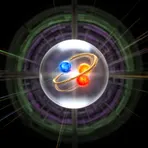
A heavy neutral particle made of a charm quark and its antiparticle
Surface Forms
Morphology
The compound is a straightforward naming construction: 'psi' (a Greek-letter label) combined with 'particle' yields 'a particle named psi', so a learner who knows both constituents can infer it refers to a kind of particle. Although the full scientific details (that it is a specific meson, J/psi) require domain knowledge, the basic referential meaning is transparently derivable from the parts.
Etymology
Psi particle: The name psi particle comes from the Greek letter psi, because the scientists used that letter as a label when they first saw the new particle. One team called it 'J' and another called it 'psi', so the full name 'J/psi' stuck and now the name simply points to that particular heavy particle.

