

muscular contraction


 1
3.5
1
3.5
- noun
- /ˈmʌskjələr kənˈtrækʃən/
- Specialized
- So it's, it's basically waves of muscular contraction running forwards down this creature.
- force of muscular contraction
Examples
-
Similarly, a chronic muscular contraction that not only constrains movement but also results in tension and pain may nonetheless go unnoticed because it has become habitual.
Academic text (2000) -
Efficient vocal fold vibration is a dynamic blend of proper muscular contraction and balanced respiratory support.
Academic text (2008) -
Concentrating on different muscular contractions and varying starting positions, etc.
Blog text (5) -
Just the, Yep, just the musculature, the the enzymatic action in the muscular contraction, all of those things are of great benefit.
-
Since this display of maximal strength always depends upon muscular contraction speed, strong athletes do not necessarily possess a high rate of force development.
Blog text (5) -
When muscular contraction or respiratory support is systemically or actively changed, vocal fold movement is altered, as is the quality of voice that is produced.
Academic text (2008) -
That retraction is partially mediated by the motor protein myosin, which is also responsible for our own muscular contractions.
Academic text (2012) -
Performing squats from varying depths, varying speeds, varying ranges of motion, and varying types of muscular contractions.
Blog text (5) -
According to self-conducted research by Bret Contreras, maximum muscular contraction of individual leg muscles is best done with separate lifts.
Blog text (5) -
A proper muscular contraction enables the heart to pump blood effectively throughout the body.
Synonyms
 80
4.4
80
4.4
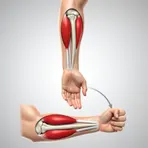
Tightening and shortening of a muscle to cause movement
 3
3.4
3
3.4
A muscle that becomes shorter or tighter and causes movement and tension
Antonyms


How Strong

Surface Forms
Morphology
The meaning is directly compositional: 'muscular' (relating to muscles) combined with 'contraction' (shortening/tightening) yields the clear sense of a muscle shortening or tensing. This is a standard medical/biological noun phrase with transparent parts and cross‑linguistic parallels, so a B1 learner who knows both words would readily understand it.
Etymology
Muscular contraction may come from old Latin words: muscular from 'musculus' meaning 'little mouse' because muscles under the skin looked like small mice, and contraction from a word meaning 'to get shorter'. So the phrase paints the picture of a muscle getting shorter or tight, which is why it means a muscle tightening or shortening.