
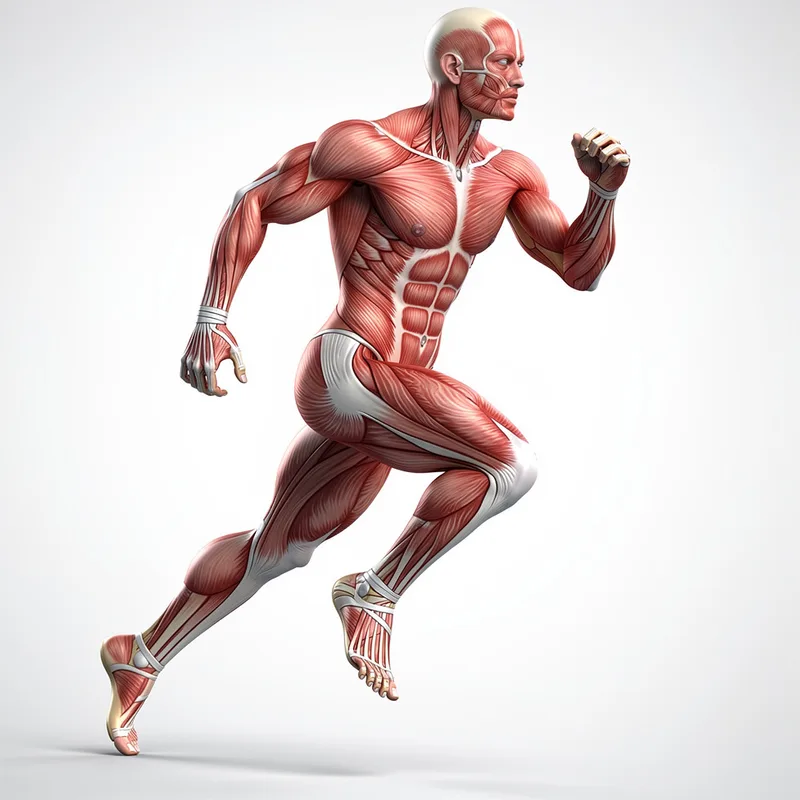
muscular
 20
3.3
20
3.3

- adjective
- /ˈmʌskjələr/
- Specialized
 :
muscular
:
muscular
- After years of training, he developed a strong and muscular physique.
- muscular contraction
- muscular strength
- muscular endurance
How many sets and how often should one perform training for muscular endurance and when?
- How many sets and how often should one perform training for muscular endurance and when?
- The state of my cognitive health, my muscular health, my skin health, my is correlated to.
- And if the, but the cramp was on one side and if it was muscular, that's probably not related to this.
- So speech is there's a muscular component like you said, there's like the act of producing sounds.
- You're saying focus on muscular movements, focus on resistance training rather than relying on cardio.
- But there's clearly a influence of hard work at the neural level and then at the muscular level for increasing testosterone.
- And once you've got those proteins in in this like stringy muscular form, like it's going to taste pretty similar.
Examples
-
I was born with a disability, a disease called spinal muscular atrophy.
-
The skin was soft and thin, but underneath it, his arm was muscular and pulsing.
Fiction book (1998) -
Her massive head turned on the muscular neck, looking in all directions.
Fiction book (1990) -
If you experience any symptoms... unexpected shaking, muscular pain, loss of motor function, you need to let us know immediately.
-
Due to their skeletal and muscular structure, they may not have a full range of motion.
Academic text (1996) -
Her legs were whiter and more muscular than he would have expected.
Fiction book (1992) -
Just take your blood count, examine your muscular coordination and study your reflexes.
-
Claire has muscular dystrophy, which means severe muscle weakness.
-
Boston Children's Hospital diagnosed him as suffering from muscular dystrophy.
-
Thus, physical fitness is generally considered to be composed of aerobic fitness, muscular strength, and muscular endurance.
Academic text (1992)
Synonyms
 2
3.7
2
3.7
A person with large, strong muscles

Has strong, large muscles that show on the body

Having a strong body like a fit athlete

Having strong, clearly visible muscles from exercise
Compounds

- Specialized
8
5.3
Inherited diseases that gradually make the muscles used for movement weak and smaller

- Specialized

 1
3.5
1
3.5
A short tightening of a muscle that makes it shorten or stiffen


- Specialized
A genetic muscle disease that starts in the teens and slowly makes the arms, legs, and body weak

- Specialized
A muscle disease that often runs in families and starts at 40–60, causing weakness in hands and lower legs

- Specialized
A serious inherited muscle disease that mainly affects boys and makes muscles become weaker over time

- Specialized
A disease that slowly makes the shoulder and hip muscles weaker and smaller

- Specialized
Tissue made of muscle cells that makes the body move and produce force
- Specialized
A slight constant tension in muscles that helps hold posture and keep joints stable

- Specialized
A genetic disease causing slow muscle weakness and trouble relaxing muscles, often in face and hands

- Specialized
A rare inherited muscle disease that starts in adulthood and first weakens the eyelids and throat, causing swallowing problems
How Deep
- Specialized
1
9.9

- Specialized
- Specialized
20
3.3
- Specialized
8
7.2
20
5.3
Surface Forms
Morphology
Etymology
Muscular comes from the Latin musculus 'little mouse', the old name for the body's moving parts. So muscular simply means 'about the muscles', which is why we use it for muscle pain or muscle systems.