
erosive
 1
6.4
1
6.4

- adjective
- /ɪˈroʊsɪv/
- The abiotic effects of flooding, and especially the corresponding erosive forces, are exacerbated in the presence of different types of river ice that confine and divert the flow and constitute direct scouring agents themselves.
- erosive action
- erosive force
- erosive power
Loading YouTube…
Watch on YouTubeWere it not for our atmosphere and our weather and other erosive corrosive forces, we would look just like the moon.
- Were it not for our atmosphere and our weather and other erosive corrosive forces, we would look just like the moon.
Examples
-
The new inlets widen and shift, yielding to the erosive force of tide and wind.
Academic text (1990) -
As a coastline accretes, mangroves invade the new soil and hold it against the erosive action of wind, wave, current, and tide.
Academic text (1990) -
But the ones on the moon survive because the moon does not have many erosive agents, and the ones on the Earth disappear.
-
Were it not for our atmosphere and our weather and other erosive corrosive forces, we would look just like the moon.
-
Produced at high temperatures and pressures, it is both highly corrosive and erosive.
Academic text (2005) -
A thick blanket of crimson clover now covers the rich soil to protect it from the erosive forces of falling raindrops.
Blog text (30) -
"We are conducting experiments on two farms in Minnesota and South Dakota to find ways to manage this land so that it doesn't revert to the erosive conditions that existed before it was put into the CRP," says Voorhees.
Academic text (1997) -
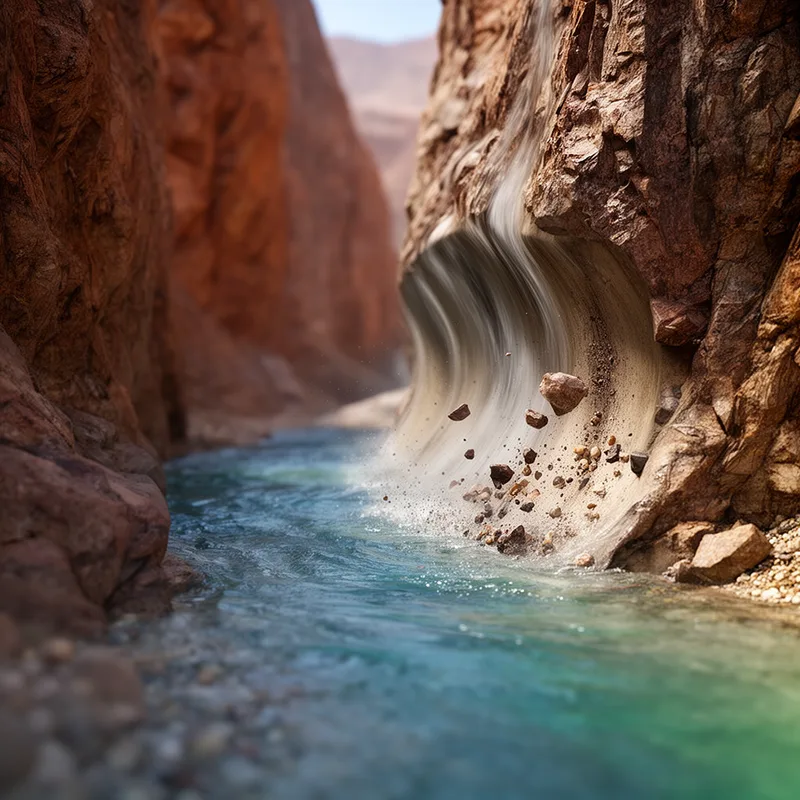
Water flowing over rocks can be a strong erosive force that shapes the landscape over time.
-
The erosive effects of acid rain can damage buildings and monuments if left untreated.
-
Wind is often considered an erosive agent, wearing away soil and rock in dry areas.
Synonyms
 14
6.6
14
6.6
Able to eat away materials by a chemical reaction, for example strong acids
 8
7.6
8
7.6
Able to burn or damage skin


 1
8.7
1
8.7
Causing things to break into smaller parts

Able to eat away materials by chemical action like a strong acid

A very strong acid that can burn skin and metal

Causing materials to break down into smaller parts
Antonyms

How Erosive

Surface Forms
Morphology
Etymology
The word erosive comes from Latin parts e- ('away') and rodere ('to gnaw'), so it means 'to gnaw away'. Picture a mouse or slow rain chewing at rock or metal; that's why erosive describes something that slowly wears things down.