
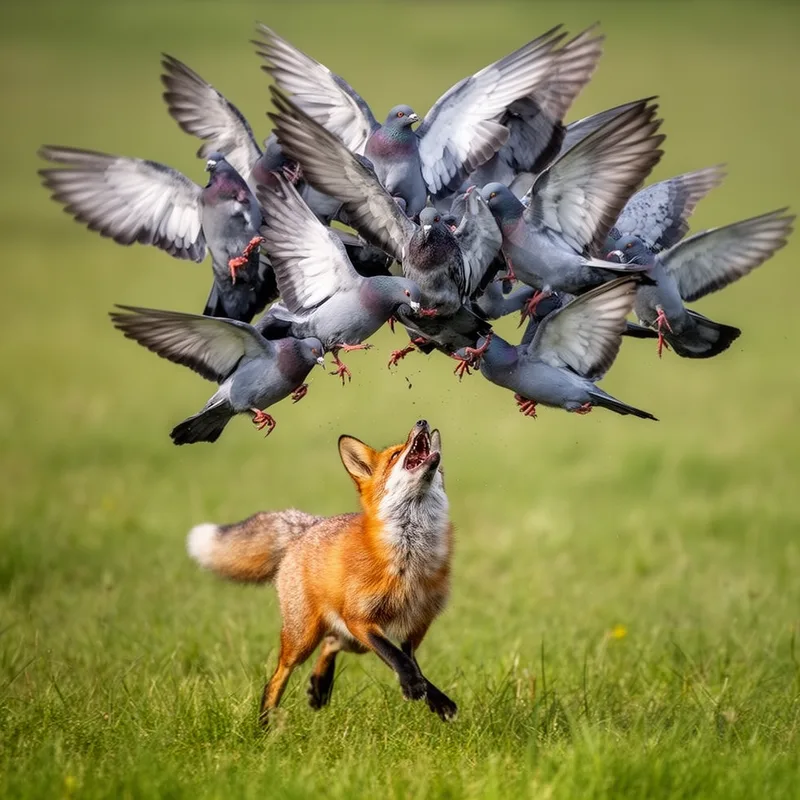
to take flight
 11
3.5
11
3.5

- phrasal verb
- /teɪk flaɪt/
- When the fire alarm rang, everyone took flight to escape the building quickly.
- a bird takes flight
Loading YouTube…
Watch on YouTubeEverything is there for you to explore if you get out of that nest and take flight.
- Everything is there for you to explore if you get out of that nest and take flight.
- And further proof that Langley was motivated by the wrong thing, the day the Wright brothers took flight, he quit.
- Now dig up and run or fight or flight is kind of a, they're either going to stay there and fight out the cold or they're going to, they better take flight.
- When the doves have taken flight, only the memory of that flight remains.
- It's like, it's as if you are taking flight and you didn't even, you're not trying.
Examples
-
As he gallops, the crow takes flight and swoops toward us.
Fiction book (1999) -
Perhaps we could have made our souls take flight together.
-
One more step and he takes flight.
-
I think I'll take flight.
-
By the time I could spot them, the birds had long since taken flight.
Fiction book (1990) -
I wish that bird would take flight, head south, and land on the Capitol dome.
Academic text (2004) -
Every morning the petrels take flight just before the wind turns east.
-
Inside every girl, a secret swan slumbers, longing to burst forth and take flight.
-
The latch sprung open, and again the crowd burst into applause as the birds took flight.
Fiction book (1998) -
Above the fortress tower, he sees a flock of birds taking flight, rising up gracefully towards the desert sun.
Fiction book (2002)
Synonyms
 ∞
1.0
∞
1.0
To move a boat fast in the same direction as the wind
 ∞
1.0
∞
1.0
To get away from a place where you are kept or are in danger
 550
1.6
550
1.6
To leave secretly and quickly to get away from danger or control
 344
4.1
344
4.1
To move people out of a place because it is dangerous, for example during a fire
 333
1.8
333
1.8
Pass very quickly, often used for time
 331
2.4
331
2.4
To run away from a place because it is dangerous
 273
3.2
273
3.2
To leave a place quickly, often to travel somewhere else
 260
3.7
260
3.7
To leave a place or person suddenly, often without saying goodbye
 78
2.0
78
2.0
Leave a place suddenly, often to avoid someone or something
 36
5.3
36
5.3
To try to escape quickly, often by running
 25
3.9
25
3.9
Get away very quickly to avoid being hurt
 18
8.3
18
8.3
To leave a place very quickly to escape danger or trouble
 16
8.4
16
8.4
To leave a place quickly to avoid trouble or danger
 12
7.9
12
7.9
To leave a place suddenly without permission
 7
9.2
7
9.2
Leave a place quickly to avoid trouble or danger
 7
5.6
7
5.6
To leave a place quickly to escape danger or trouble
 5
7.2
5
7.2
Leave quickly to go somewhere or to avoid trouble
 4
7.8
4
7.8
To run away quickly to escape danger
 4
4.6
4
4.6
To begin flying and rise into the sky
 3
5.8
3
5.8
Begin to fly, like birds rising into the air or projects starting to do well
 2
2.5
2
2.5
Leave a place quickly because you are in a hurry
 1
8.1
1
8.1
To leave a place quickly to be safe


 1
6.0
1
6.0
To leave a place quickly to avoid danger or trouble
 1
6.1
1
6.1
Run away quickly to escape danger or trouble

Run quickly into the woods to escape danger

To run away quickly to avoid being caught
Antonyms


How Fast

Surface Forms
Morphology
The sense 'to escape or run away' is directly derivable from combining 'take' (to begin or adopt) with 'flight' (the act of fleeing); the phrase literally means to begin flight/flight from a situation. Although 'flight' can also mean air travel, the fleeing sense is common and cross-linguistically mirrored (e.g. French prendre la fuite), so a B1 learner who knows both words can normally infer the idiomatic meaning from context.
Etymology
Take flight comes from the image of birds or animals suddenly beginning to fly: they literally take flight to get away from danger. So, the phrase now means 'to escape' or 'run away quickly'.