
stop consonant
- noun
- /stɑp ˈkɒn.sə.nənt/
- Specialized
 :
consonante oclusiva
:
consonante oclusiva
- Children learning to speak often struggle with stop consonants, which require precise control of airflow.
- voiced stop consonants
Examples
-
The authors tested the stability of phoneme percepts by analyzing participants' ability to identify voiced and voiceless stop consonants.
Academic text (2012) -
Differences in VOT are perceptually essential to discriminate between voiced and voiceless stop consonants.
Academic text (2012) -
Diminished Speech Perceptual Acuity for Stop Consonants in Stuttering
Academic text (2012) -
The error pattern of stopping occurs when a fricative or affricate is replaced by a stop consonant that shares the same place of articulation.
Academic text (2015) -
Only superior-inferior articulatory movements were analyzed because this is the primary dimension of movement for bilabial stop consonants.
Academic text (2011) -
Two foundational studies on this topic examined the gradual development of the voicing contrast in word-initial stop consonants.
Academic text (2012) -
Keating, P. A. (1984). Phonetic and phonological representation of stop consonant voicing. Language, 60, 286-319.
Academic text (2012) -
The four target words of the first group all had a CVC phonemic structure with a stop consonant (two voiced and two voiceless) preceding the schwa.
Academic text (2013) -
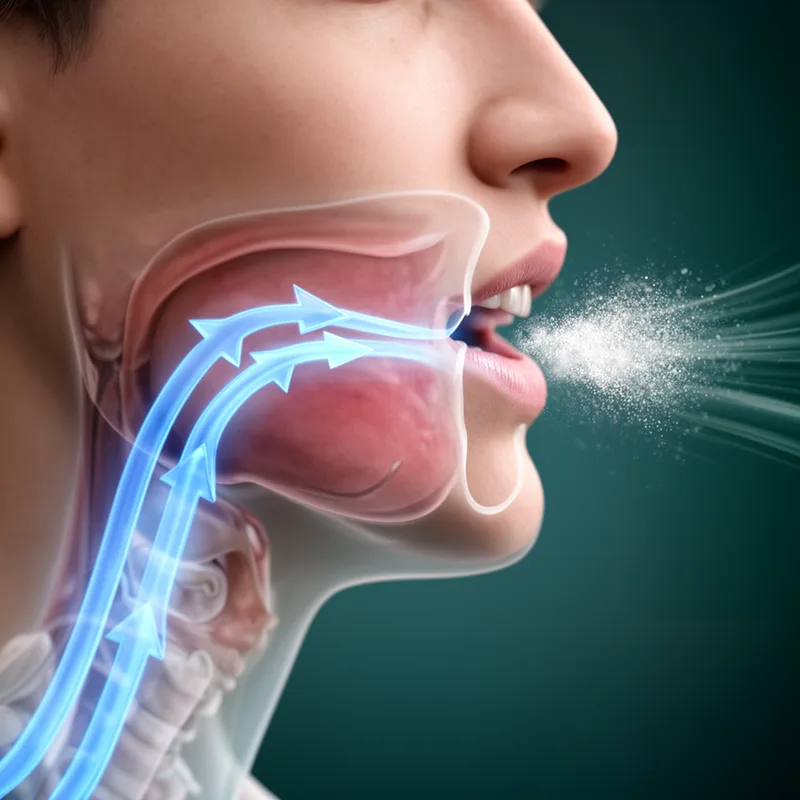
In English, stop consonants like 'p' and 't' are produced by completely blocking airflow before releasing it.
-
A classic example of a stop consonant is the 'k' sound in the word 'cat', where air is stopped before it is released.
Synonyms

 4
6.0
4
6.0

A consonant sound made by blocking the air and then releasing it

A speech sound made by stopping the breath completely and then letting it out

A speech sound, like p or b, made by stopping the air and then letting it out quickly

A consonant sound made by stopping air in the mouth then letting it out suddenly, like p or b
Antonyms

- Specialized
A speech sound made by narrowing the mouth so air keeps flowing
How Prolongable
- Specialized
23
1.0

- Specialized

 1
7.6
1
7.6
- Specialized
- Specialized
- Specialized
- Specialized
Surface Forms
Morphology
Etymology
Stop consonant comes from the simple image of 'stopping' the flow of air in the mouth and then 'releasing' it. That's why sounds like p and t are called stop consonants: stop shows the brief block and consonant is the speech sound, so the sound is made by that quick block-and-release.