

monkshood
 2
9.9
2
9.9

- noun
- /ˈmʌŋksˌhʊd/
- Wildflowers that may be visible from the road include Rocky Mountain bluebells, monkshood, golden smoke, New Mexican groundsel, white lousewort, Easter daisy, and the lovely mariposa lily, whose flowers have three large white petals.
- blue monkshood
Examples
-
The herbalist cautioned me against using monkshood in remedies because of its dangerous properties.
-
While hiking, I spotted a field of monkshood with its striking blue flowers, but I knew to keep my distance due to its poison.
-
What is the difference between monkshood and wolfsbane?
-
CAUTION: Monkshood is among the most poisonous of plants.
Blog text (19) -
Among plants he passionately favored what he called "Estonian orchids," which meant wolfsbane, monkshood, and lady's slippers, flowers of that sort.
Fiction book (1993) -
Monkshood preparations are sometimes used for the pains of neuralgia, sciatica, and arthritis, as well as for gout, rheumatism, measles, nervous fever, and chronic skin problems.
Blog text (19) -
In botanical studies, monkshood is often examined for its toxic alkaloids, particularly aconite, which can be lethal.
Synonyms
 4
9.9
4
9.9
A poisonous plant whose touch or eating can make you sick
 1
9.9
1
9.9
A poisonous plant with thick roots and leaves like a hand, often with blue or white flowers


 1
9.9
1
9.9
A poisonous plant that lives for many years with yellow flowers and broad rounded leaves
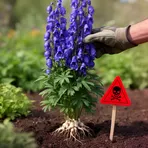
A poisonous garden plant with blue-purple hooded flowers whose leaves and roots are dangerous if eaten

A poisonous plant with hooded blue-purple flowers that grows in northern Europe

A poisonous plant with blue-purple hooded flowers

A poisonous plant with hood-shaped flowers that grows in cool Northern regions
Surface Forms
Morphology
Etymology
The word monkshood comes from monk and hood ('a covering for the head') because the plant's flower looks like a monk's hood. That's why the name fits the poisonous plant with hood-shaped blue or purple flowers.