
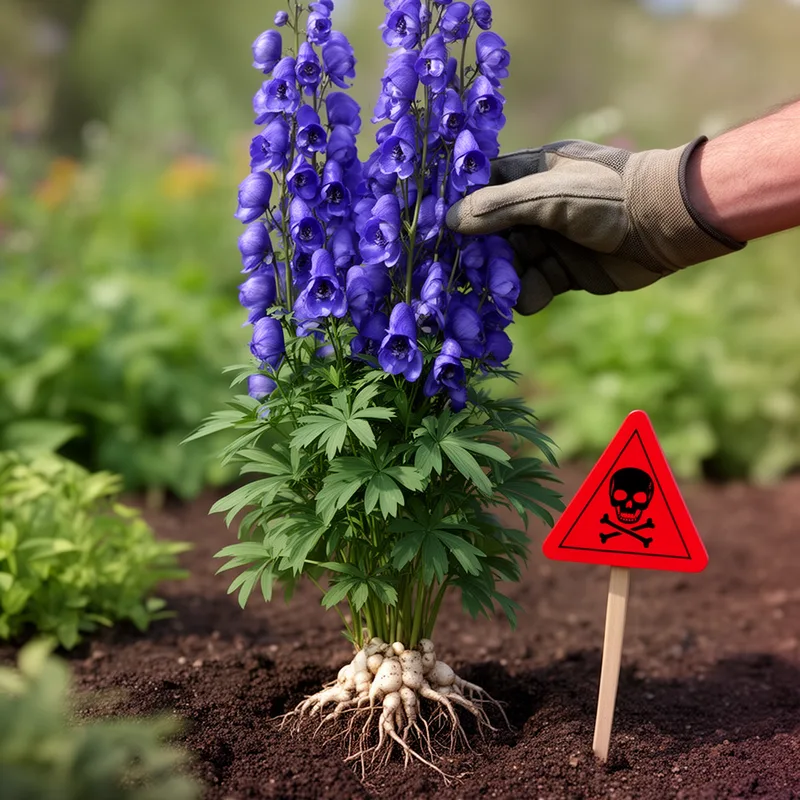
Aconitum napellus
- noun
- /ˌækəˈnaɪtəm ˈnæpələs/
- Specialized
- The roots of Aconitum napellus are highly toxic if ingested.
Examples
-
Gardeners admire the striking flowers of Aconitum napellus, but handle the plant with care.
-
Some traditional remedies once used Aconitum napellus, despite its dangerous properties.
-
The Aconitum napellus is known for its toxicity.
-
Many gardeners avoid planting Aconitum napellus in their yards.
-
The roots of Aconitum napellus are highly toxic if ingested.
-
Some traditional remedies once used Aconitum napellus, despite its dangerous properties.
-
Gardeners admire the striking flowers of Aconitum napellus, but handle the plant with care.
Synonyms

 4
9.9
4
9.9

A poisonous plant whose touch or eating can make you sick
 2
9.9
2
9.9
A poisonous plant with blue or purple flowers shaped like a hood
 1
9.9
1
9.9
A poisonous plant with thick roots and leaves like a hand, often with blue or white flowers

A poisonous plant with hooded blue-purple flowers that grows in northern Europe
Surface Forms
Morphology
Aconitum + napellus
This is a Latin binomial (scientific) name rather than a compositional English phrase; knowing 'Aconitum' as a plant genus and an unknown element 'napellus' does not allow a B1 learner to derive the full descriptive meaning (poisonous, hooded blue‑purple flowers, yields aconite). Species epithets are not productive English morphemes, so the overall meaning is not predictable from the parts.
Etymology
Aconitum napellus has dark, hood-shaped flowers, so people call it monkshood because the flower looks like a monk's hood. It was also called wolfsbane since hunters used its strong 'poison' to kill wolves, which is why the name tells us the plant is very 'poisonous'.