

helmet flower
- noun
- UK
- The helmet flower is admired for its striking blue-purple blossoms but must be handled with care.
Examples
-
Botanists warn that every part of the helmet flower is highly toxic to humans and animals.
-
She planted a helmet flower in her garden, unaware of its poisonous properties.
-
The helmet flower blooms beautifully in the spring.
-
In my garden, I planted several helmet flowers this year.
-
Botanists warn that every part of the helmet flower is highly toxic to humans and animals.
-
She planted a helmet flower in her garden, unaware of its poisonous properties.
-
The helmet flower is admired for its striking blue-purple blossoms but must be handled with care.
Synonyms

 4
9.9
4
9.9

A poisonous plant whose touch or eating can make you sick
 2
9.9
2
9.9
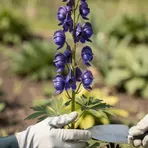
A poisonous plant with blue or purple flowers shaped like a hood
 1
9.9
1
9.9
A poisonous plant with thick roots and leaves like a hand, often with blue or white flowers


 1
9.9
1
9.9
A poisonous plant that lives for many years with yellow flowers and broad rounded leaves
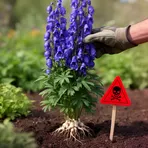
A poisonous garden plant with blue-purple hooded flowers whose leaves and roots are dangerous if eaten

A poisonous plant with blue-purple hooded flowers

A poisonous plant with hood-shaped flowers that grows in cool Northern regions
Surface Forms
Morphology
The compound combines 'helmet' (protective head covering) + 'flower' in a straightforward descriptive way, so a learner would naturally interpret it as a type or flower that resembles a helmet (i.e., a helmet-shaped flower). While specific encyclopedic details like its poisonous nature or the exact species are not derivable from the parts, the basic referential meaning 'a kind of flower' formed by the two constituents is immediately clear to a B1 learner.
Etymology
The name helmet flower comes from the plant's flowers, which have a hood that looks like a small helmet on a flower. Because the whole plant is very 'poisonous', that strong image helps people remember it is dangerous.