
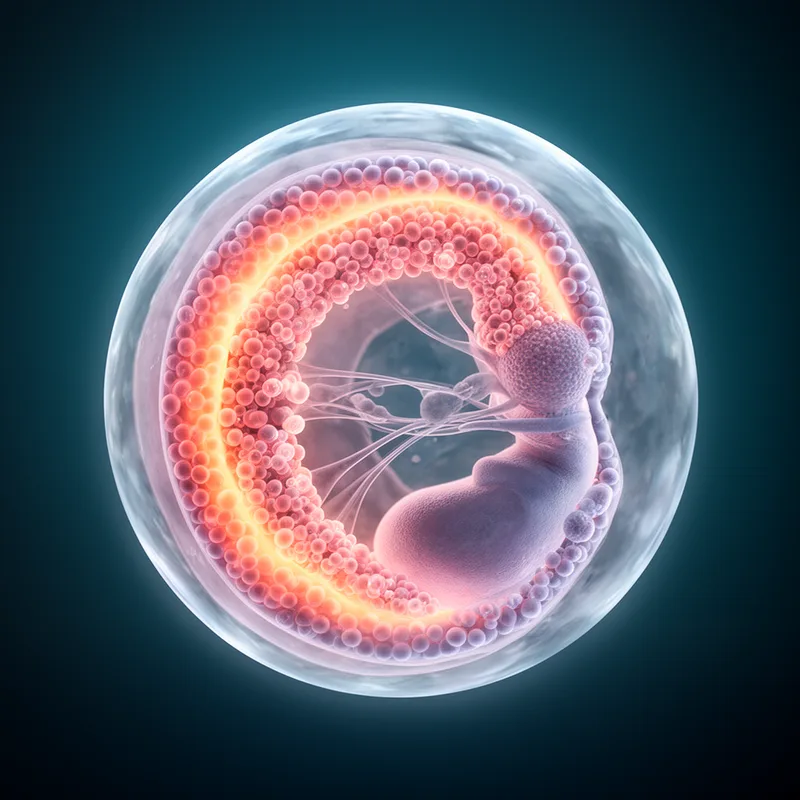
germinal area
- noun
- Specialized
- During early embryonic development, the germinal area gives rise to essential tissue layers.
Examples
-
Scientists study the germinal area to understand how organs begin to form in embryos.
-
Damage to the germinal area can disrupt normal cell differentiation.
-
The germinal area is crucial for tissue development.
-
In the embryo, the germinal area forms early.
-
The germinal area is where the embryonic cells start to organize into distinct tissues.
-
In embryos, the germinal area plays a vital role in forming various organs.
-
Research on the germinal area helps scientists learn about early developmental processes.
Synonyms
A main group of cells in a young animal before birth that forms body parts

A layer of cells that forms on the inside of an early embryo around the yolk

The inner layer of an embryo that becomes the lining of the gut and lungs
The inner layer of cells in an embryo that becomes the lining of the gut and lungs
A layer inside an embryo that becomes the lining of the gut and lungs

Innermost layer of an embryo that becomes the lining of the digestive and breathing systems

A layer of cells inside an embryo that forms the lining of the gut and breathing tubes
Surface Forms
Morphology
The phrase is compositionally interpretable as ‘an area that is germinal/foundational,’ so a learner who knows the words could guess it refers to a region where something originates or develops. However, 'germinal' is relatively low-frequency and the precise embryological sense (a specific cell layer in the blastula) is technical, so the exact biological meaning is not fully predictable without domain knowledge.
Etymology
Germinal area may come from a word for a 'seed' or 'sprout', with germinal meaning new growth and area meaning a small place. It names the small part of an early embryo where cells 'sprout' into different tissues, so it means the layer that forms the body's tissues.

