
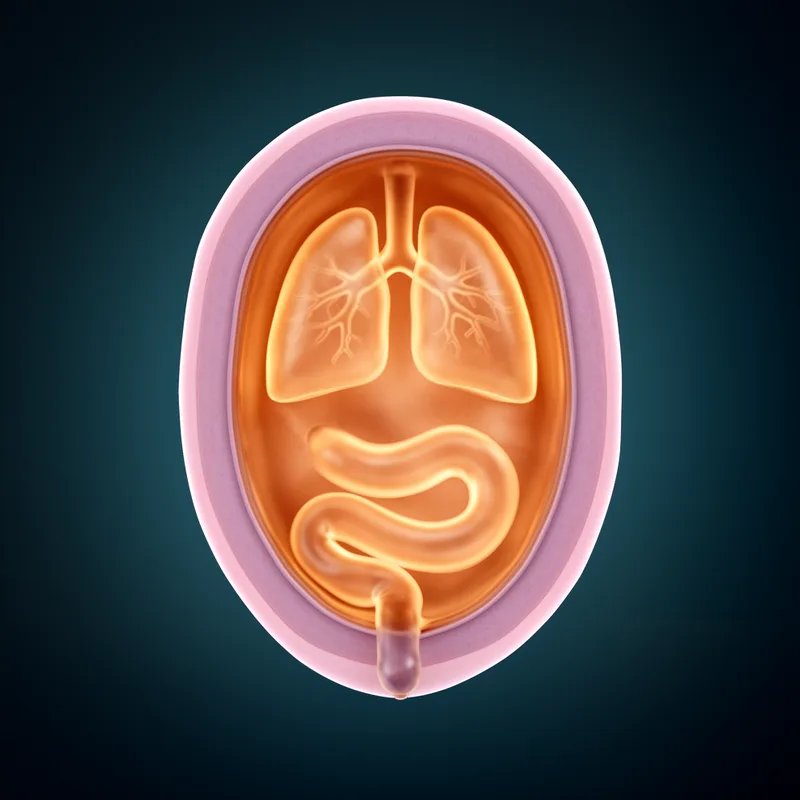
entoblast
- noun
- /ˈɛntəˌblæst/
- Archaic
- The entoblast gives rise to the epithelial lining of the digestive tract.
Examples
-
The entoblast forms the lining of the gut.
-
Scientists study the entoblast to better understand organ formation in early embryos.
-
During embryonic development, the entoblast differentiates into several vital internal organs.
-
During embryonic development, the entoblast plays a crucial role.
-
During embryonic development, the entoblast develops into the lining of the digestive system.
-
The entoblast gives rise to the epithelial tissue that lines the respiratory tract.
-
Scientists study the entoblast to understand how it contributes to gut formation.
Synonyms
A layer inside an embryo that becomes the lining of the gut and lungs
The inner layer of cells in an embryo that becomes the lining of the gut and lungs

The inner layer of an embryo that becomes the lining of the gut and lungs

A layer of cells inside an embryo that forms the lining of the gut and breathing tubes
Surface Forms
Morphology
entoblast = ento + blast
Both elements are Greek combining forms used in technical biology; an average B1 learner who knows common English words would not be able to derive the meaning from 'ento-' + 'blast'.
Etymology
Entoblast comes from Greek parts ento- 'inner' and -blast 'germ' or 'sprout'. So the entoblast is the 'inner germ' of an embryo that becomes the lining of the gut and lungs.

