

entoderm
- noun
- /ˈɛntəˌdɜrm/
- Archaic
- During embryonic development, the entoderm forms the basis for the lining of the digestive tract.
Examples
-
The entoderm gives rise to the lining of the gut and associated organs.
-
The entoderm forms during the early stages of embryonic development.
-
During embryonic development, the entoderm forms before many other organs appear.
-
Researchers studied the process by which cells differentiate into entoderm in early stages of growth.
-
In mammals, the entoderm gives rise to various organs.
-
The entoderm develops early in the embryo and eventually becomes the respiratory system's lining.
-
Cells that become the entoderm are crucial for forming the body's internal organs.
Synonyms
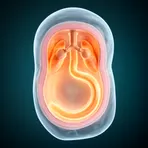
A layer inside an embryo that becomes the lining of the gut and lungs

Innermost layer of an embryo that becomes the lining of the digestive and breathing systems

The inner layer of an embryo that becomes the lining of the gut and lungs

A layer of cells inside an embryo that forms the lining of the gut and breathing tubes
Surface Forms
Morphology
entoderm = endoderm (semi-transparent) = ento + derm
'entoderm' is a variant spelling of 'endoderm' used in technical contexts; the parts are specialist combining forms, so the relation is not fully transparent to general learners.
Etymology
Entoderm comes from Greek parts ento- meaning 'within' and -derm meaning 'skin', so it literally means 'inner skin', like in epidermis where -derm also means 'skin'. That's why the entoderm is the embryo's innermost layer that later becomes the lining of the gut and the lungs.

