
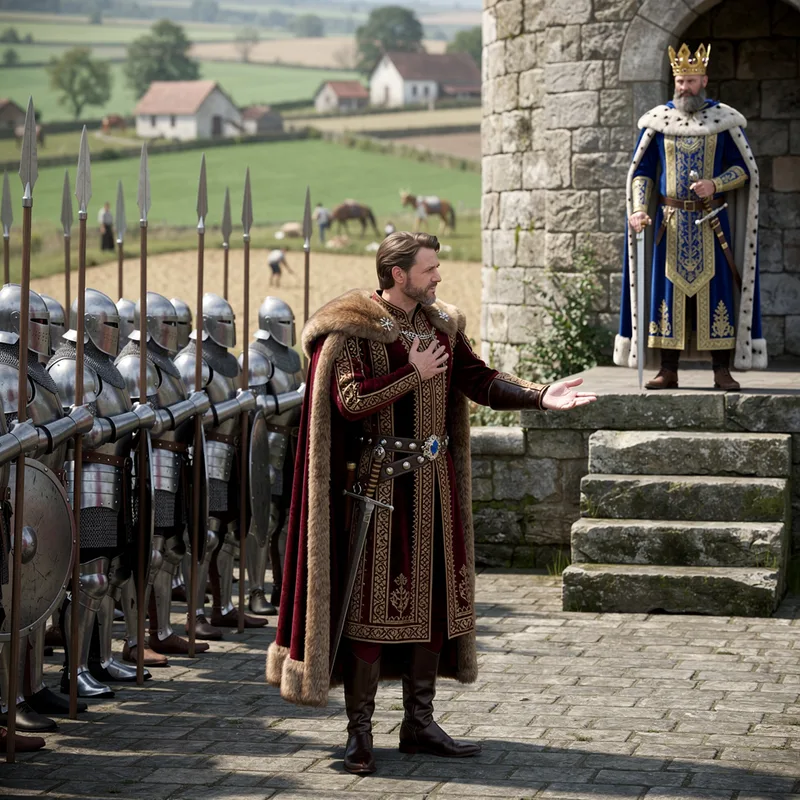
feudal lord
 2
9.5
2
9.5

- noun
- /ˈfjuːdəl lɔrd/
- The feudal lord's wealth came from the taxes paid by the peasants who worked his land.
Examples
-
They fought each other, they absorbed each other, and eventually one becomes the number one feudal Lord who takes the name king.
-
The settlement was not refortified until the sixth century A.D., but then survived into the Middle Ages, when it was ruled by the Albanian feudal lords of the Zenebishi family.
Academic text (2009) -
As the age of powerful feudal Lords ended, so too did the Age of the Castle.
-
The second sons of feudal lords had two choices: the government (read military) or the church.
Blog text (27) -
If a ruler or a feudal lord made generous donations of paintings to a church or a monastery, he received spiritual and sometimes political support.
Academic text (2009) -
The entire village, then, belonged to one and the same feudal lord, the heir to a long progeny of sheiks.
Fiction book (1994) -
Prior to the Peace of Westphalia, most polities in Europe were ruled by an emperor, a leading clergyman, or a feudal lord.
Academic text (2005) -
The village clustered about the log-built stronghold of the feudal lord, with its flour mill, forge, bakery, and chapel.
Blog text (22) -
The feudal lord granted land to his knights in exchange for their military service.
-
During the Middle Ages, a feudal lord was responsible for protecting his vassals.
Synonyms
 422
4.8
422
4.8
A man who has power over people, like a ruler or noble
 20
8.0
20
8.0
A person with the lowest rank of noble title, often given by a king or queen
 14
5.6
14
5.6
A man from a high social class who has a title
 1
9.9
1
9.9
A powerful local lord in old Japan who ruled large areas and had soldiers
 1
9.9
1
9.9
A powerful noble who gets loyalty and service from knights and farmers
 1
9.9
1
9.9
A man who owned land and ruled over villagers in old France

A man who owned and ruled land and the people who worked it in old times

A person who holds land from someone above them and rents it to other people

A lord who ruled a large area in medieval Germany
How Powerful

Surface Forms
Morphology
The noun phrase is directly compositional: 'feudal' specifies the social system (feudalism) and 'lord' denotes a nobleman, so together they mean a lord within the feudal system. This adjective+noun construction follows a regular, cross-linguistic pattern, so a B1 learner who knows both constituents should be able to infer the MWE's meaning.
Etymology
The term feudal lord comes from the Middle Ages, when kings gave land to a noble and the lord lived in a castle and ruled the people on that land. In return the lord promised soldiers and loyalty to the king, so feudal lord means 'a man who held land from the king and promised to fight for him and be loyal'.