
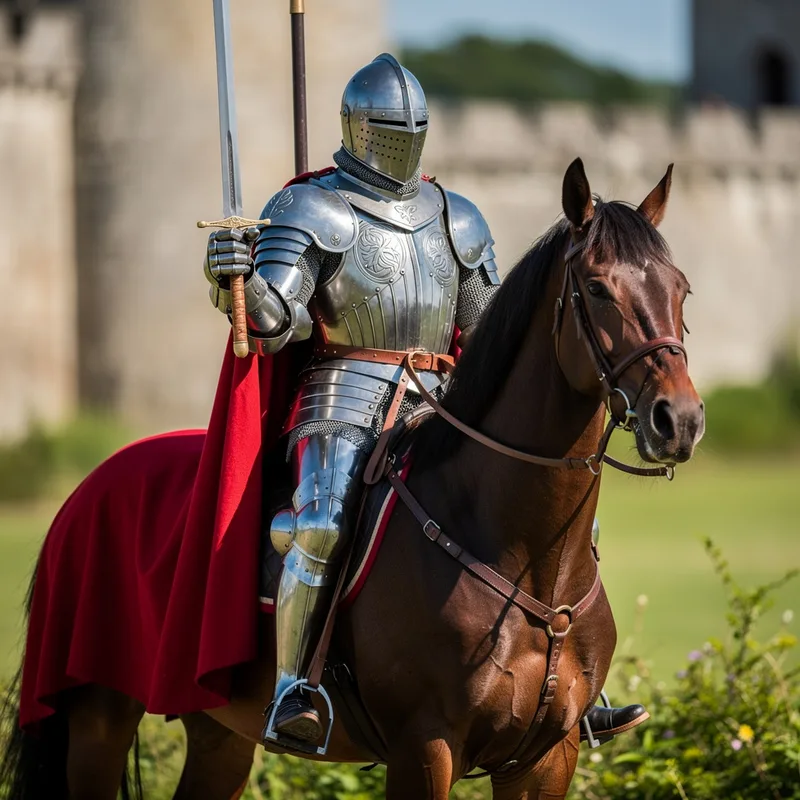
knight
 178
6.5
178
6.5

- noun
- /naɪt/
- UK
- In the Middle Ages, a noble man trained to be a knight would often fight for his lord in battle.
- become a knight
- serve as a knight
- a knight in armor
Loading YouTube…
Watch on YouTubeOn the plains of Mangeta, the Shiril Knights, what I prophesied, came to pass.
- On the plains of Mangeta, the Shiril Knights, what I prophesied, came to pass.
- But she who served great powers, she, the priestess of Grim Knight, was free of that pettiness.
- But the next minute, I mean, they're all dames and Knights and God knows what.
- What I love about this clip is that it starts with a knight running whilst wearing armour.
- His name is Percy and he's a knight like these.
Examples
-
What are you, a knight of the Round Table?
-
We shall win the true crown of glory like the knights of old.
-
Why do you want to be a knight so much?
-
"Why did you want to be a knight when you were a boy?" asked Annabelle.
Fiction book (1990) -
Fear not, for here come the gallant knights to save us.
-
At King Arthur's court, a new knight kissed the hand of his sponsor.
Fiction book (1990) -
At home, the knights dressed like the locals, in silk burnous and even turbans.
Academic text (2011) -
The courtyard's central stone watchtower was built in the 1190s so the knights could protect merchants when robbers attacked.
Academic text (2008) -
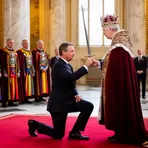
The king honored him for his bravery and appointed him a knight in a grand ceremony.
-
The story of King Arthur and his knights of the Round Table is legendary in British history.
Synonyms
 1
7.9
1
7.9
A soldier or knight who fights while riding a horse

A person given the title of knight for service, often in France

A knight from long ago who fights to protect others and keep honor
Antonyms

Compounds
- Literature
11
9.7
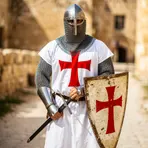
A Christian warrior from the Middle Ages who protected pilgrims and holy sites in Jerusalem

- Literature
4
9.1
A member of King Arthur's court who sits at the Round Table and is brave and fair

 1
8.8
1
8.8
A member of a Masonic group that uses rituals and symbols from a medieval Christian military order
- Archaic

 1
9.9
1
9.9
A person from the Middle Ages who travels to find adventures and help people

- Slang
1
8.3
A person who defends someone online to seem morally better or get attention




- Archaic
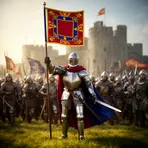
A knight honored for bravery who can lead soldiers under his square flag


- Archaic
A person honored for great bravery who leads troops and carries a square banner

- Archaic
A person who performs skilled whip tricks in rodeos or who is very strict about rules
How Powerful

Surface Forms
Etymology
The word knight comes from the Old English word cniht, which meant 'boy' or 'servant'. As some of these servants became trained horse soldiers, knight came to mean a mounted warrior and later an honor like 'Sir', so today's knight can be a medieval horse soldier or a person given a special title for service.