

knight banneret
- noun
- Archaic
- As a knight banneret, he had the privilege of leading his own squadron under his personal banner.
Examples
-
Many stories of the Middle Ages recount the exploits of the knight banneret in service to the crown.
-
The king bestowed the title of knight banneret upon him after his courageous deeds in battle.
-
A knight banneret is a title of honor.
-
The king appointed him a knight banneret after his bravery in battle.
-
The king appointed Sir Thomas as a knight banneret after he bravely led the cavalry to victory in battle.
-
Only a knight banneret can display a square banner on the battlefield, signifying his higher rank among the knights.
-
During the ceremony, he was officially recognized as a knight banneret, allowing him to command the troops with a displayed banner.
Synonyms

 178
6.5
178
6.5

A man trained to fight on horseback in the Middle Ages or one given the title Sir by the monarch

A person honored for great bravery who leads troops and carries a square banner
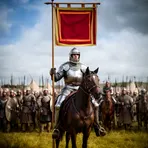
A knight who leads his own troops under a square banner
How High

Surface Forms
Morphology
The term is essentially compositional in that it denotes a subtype of knight — a banneret — so a learner who knows 'knight' and 'banneret' would understand it refers to a particular rank or kind of knight. However, the precise historical details and ceremonial privileges (honour for bravery, right to display a square banner) are culturally specific and not predictable from the constituent meanings alone, making the expression only partially transparent.
Etymology
Knight banneret comes from the Middle Ages, when a knight was honoured and given a small square banner to carry as he led his own group. Being allowed to carry that banner showed higher rank and the right to command, so the term came to mean 'a knight who could display a personal banner and lead others'.