

banneret
- noun
- /ˈbænərɛt/
- Archaic
- The banneret led his troops into battle with great courage.
Examples
-
The king rewarded him for his valor by making him a banneret.
-
As a banneret, he commanded respect both on the battlefield and in court.
-
In medieval England, a banneret led his followers into battle beneath a distinctive square banner.
-
Richard was honored as a banneret for his bravery in the last war.
-
In medieval times, a banneret would lead his troops into battle under his own standard, showcasing his honor and bravery.
-
The banneret proudly displayed his banner during the tournament, demonstrating his noble status among the knights.
-
After proving his valor in combat, he was elevated to the rank of banneret, entitled to lead men into battle.
Synonyms

 1
7.9
1
7.9

A soldier or knight who fights while riding a horse

A person honored for great bravery who leads troops and carries a square banner
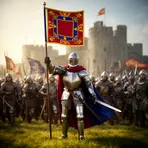
A knight honored for bravery who can lead soldiers under his square flag
Compounds
- Archaic
A knight honored for bravery who can lead soldiers under his square flag
Surface Forms
Morphology
banneret = banner (semi-transparent) = banner + et
The form shows 'banner' + the diminutive/agentive suffix '-et', but '-et' is a non-productive borrowing in modern English and the specialized historical rank is not fully predictable from the parts.
Etymology
The word banneret comes from the common word banner ('flag') plus the old ending -et, which shows a small thing or a person connected to something, so it can be read as 'one with a flag'. That's why a banneret was a knight who had his own banner and could lead troops under that flag.