
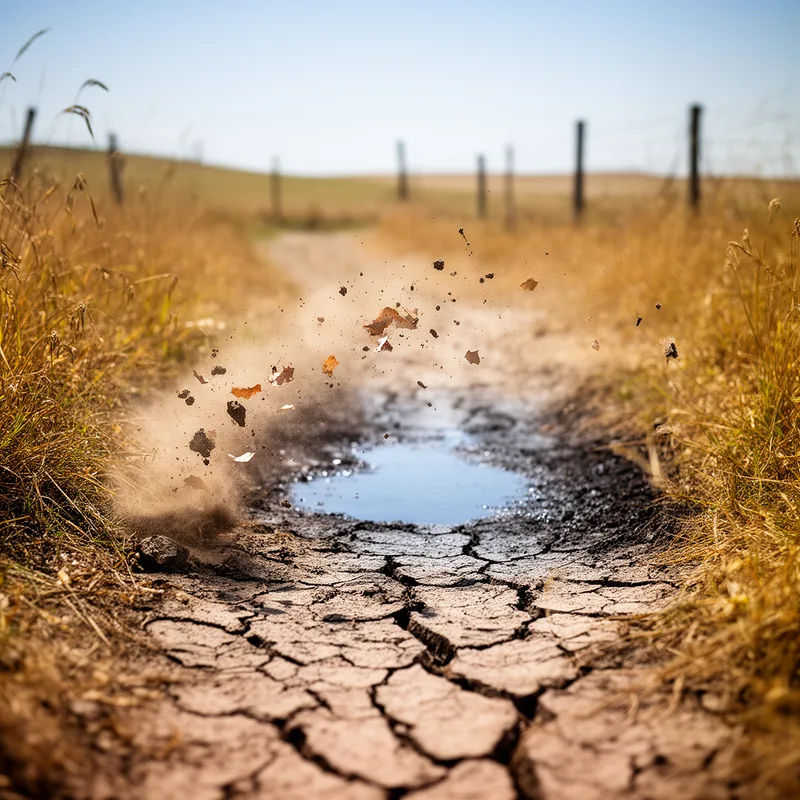
to dry up and blow away
 1
8.2
1
8.2

- phrasal verb
- Informal
- I felt sorry for him, eating outside with his family on a day when everything around us looked bleached white, as if the town itself might dry up and blow away.
Examples
-
Without adequate rainfall, the crops will dry up and blow away by the end of summer.
-
If the community doesn't support the local store, it might dry up and blow away soon.
-
He'll dry up and blow away.
-
The hope on both sides is that the opposition will eventually dry up and blow away.
Academic text (2006) -
NIH used to do that, but any corporate project I ever saw was likely to dry up and blow away overnight: the new VP didn't think progress was being made rapidly enough, was the usual reason given.
Blog text (28) -
Many small businesses in the area could dry up and blow away if they don't receive more customers.
Synonyms
 ∞
1.0
∞
1.0
To stop being seen or to no longer be there
 840
4.8
840
4.8
To stop being felt, as a feeling or idea
 531
1.2
531
1.2
To slowly become less visible, bright, or loud
 463
1.0
463
1.0
To stop being seen or felt
 421
3.0
421
3.0
Disappear suddenly and completely for no clear reason
 91
4.4
91
4.4
To become dry and weak, as with plants or feelings
 47
3.7
47
3.7
To stop existing over time, for example animals or traditions
 21
5.8
21
5.8
Plants or animals gradually become fewer until none remain
 19
2.7
19
2.7
To lose all water or moisture so it has none left
 18
5.5
18
5.5
Plans or hopes suddenly fail and disappear for good
 16
4.2
16
4.2
To slowly become weaker or fall apart because it is not cared for
 12
3.5
12
3.5
To slowly disappear or stop existing
 11
3.5
11
3.5
Become small, dry, and wrinkled because it loses water
 11
6.8
11
6.8
To stop working or fail completely
 9
5.6
9
5.6
To slowly become weaker and then stop
 8
4.2
8
4.2
To become quieter and then stop
 8
4.4
8
4.4
To vanish suddenly with no trace
 7
5.5
7
5.5
To become weak and thin because of sickness or not eating enough
 7
6.6
7
6.6
To be completely ruined and lose all value
 4
5.6
4
5.6
To disappear or fall very quickly, for example when money loses value
 1
8.1
1
8.1
Disappear completely so no one knows what happened and no sign is left
 1
8.3
1
8.3
To slowly fall apart and disappear over time

To stop working or to die after a long time of getting worse
Antonyms


How Gone

Surface Forms
Morphology
The expression is a straightforward combination of two compositional verb+particle units: 'dry up' (to wither, lose moisture, or cease) followed by 'blow away' (to be carried off or disappear). A B1 learner who knows the constituent meanings can readily infer the combined sense of withering and vanishing, so the MWE is transparently built from its parts.
Etymology
Dry up and blow away may come from the image of a small stream, plant, or pile of leaves that first dry up and then blow away in the wind. So, the phrase now means 'to disappear completely' or 'to wither and vanish', often when something is left without care.