

to cordon
 24
5.8
24
5.8

- verb
- /ˈkɔrdən/
- The Army's going to cordon off the whole town.
Loading YouTube…
Watch on YouTubeSo the natural tendency is to just sort of cordon it off.
- So the natural tendency is to just sort of cordon it off.
Examples
-
On election day, police cordoned off ballot stations in opposition strongholds.
Academic text (2011) -
The Marines arrived shortly after and cordoned off the area.
Fiction book (1999) -
First we cordon off your neighborhood.
-
- Coordinate with federal authorities and cordon off the area.
-
We intend to cordon off the area and make sure the situation is contained.
-
The police have cordoned off a section of the parking lot and transformed it into a command post.
Fiction book (2002) -
It's worse downtown where police have cordoned off the train station and are searching all passengers.
-
Police have cordoned off the entire Central Heights and East Park Side areas... ...as well as Merchant and South Shoreline Boulevards in an attempt...
-
A restless crowd encircles the hospital, cordoned off by police blockades, with uniformed cops forming a human wall around people.
Fiction book (2002) -
The police decided to cordon off the scene of the accident to ensure public safety.
Synonyms
 84
3.7
84
3.7
Surround something completely, often with a wall or fence
 47
3.9
47
3.9
Stop people from entering or leaving an area by blocking it
 42
4.8
42
4.8
To stop people from entering a place by putting up a barrier
 41
6.4
41
6.4
To surround an area with a wall to protect it
 23
3.8
23
3.8
Close a road, path or entrance so people cannot go through
 20
6.3
20
6.3
Stop people entering or leaving an area by using police and barriers
 19
2.4
19
2.4
To put a barrier around land to mark or protect it
 9
6.0
9
6.0
To stop people and goods entering or leaving a place, often during war
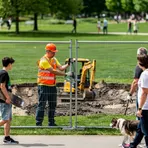 4
3.7
4
3.7
Surround an area with a fence to stop people from entering
 3
4.8
3
4.8
To keep people out of an area by putting ropes around it
 3
3.0
3
3.0
To surround an area with a barrier to keep others out

To block a place so people cannot enter, often by putting up a fence
Phrasal Verbs
Compounds




How Enclosed

Surface Forms
Etymology
Cordon (verb) comes from the idea of making a 'cord' around something, the same root as English cord. So to cordon off an area is to form a line or barrier to block it for safety or control.