
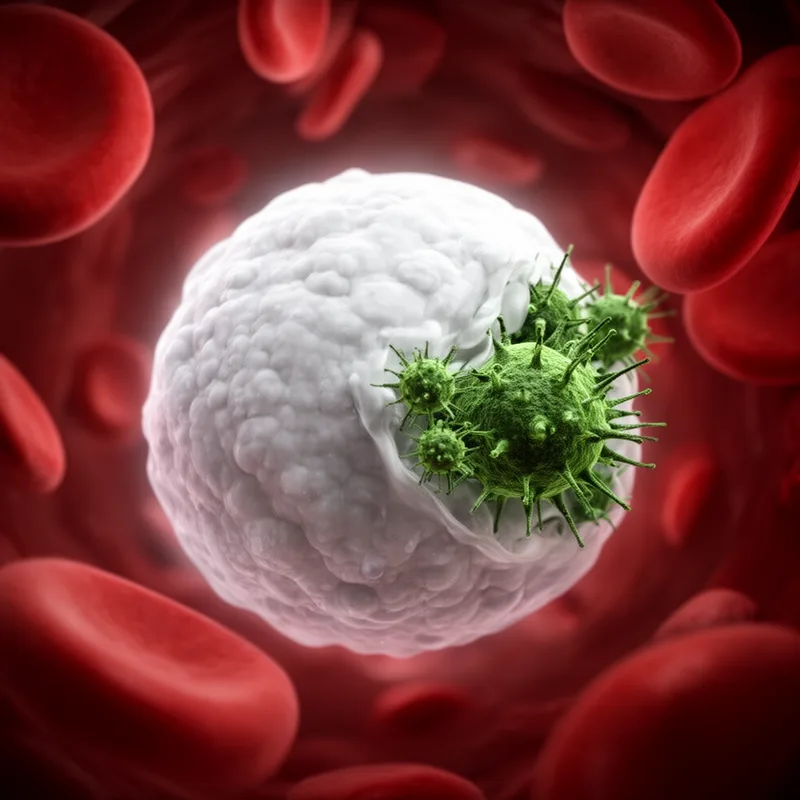
white cell
 9
3.3
9
3.3

- noun
- /waɪt sɛl/
- When fighting an infection, the body produces more white cells to combat the harmful bacteria.
- white cell count
- white cell differential
- total white cell
Loading YouTube…
Watch on YouTubeAnd then he spent literally months fiddling around with ice cold salt solutions, trying to work out ways of winkling out the white cells from these bandages.
- And then he spent literally months fiddling around with ice cold salt solutions, trying to work out ways of winkling out the white cells from these bandages.
Examples
-
When your immune system is functioning properly, it will immediately activate white cells and destroy the pathogens, keeping you healthy.
Blog text (15) -
Now those big white cells are attacking the cancer cells.
-
Your body will send white cells to attack the foreign object.
Blog text (23) -
I had literally no white cells in my blood.
-
White cell count is normal.
-
Kate's white cell count's much lower than normal.
-
Chemotherapy drugs often reduce a patient's white cell count, making them more susceptible to infection and less able to fight illness.
Academic text (2010) -
Monocytes make up approximately 5-10 percent of the total white cell count and function in the ingestion of bacteria and other foreign particles.
Academic text (2012) -
Neutrophils are the most numerous of the white cells, and they are active in the removal of invading bacteria or fungal antigens.
Academic text (2012) -
A routine blood count revealed an alarmingly high number of white cells, a mildly diminished hemoglobin, and a low platelet count.
Fiction book (1996)
Synonyms
 22
2.5
22
2.5
A cell in the blood that helps the body fight infections
 7
6.7
7
6.7
A large white blood cell that eats and removes germs and dead cells
 7
3.5
7
3.5
A blood cell that eats bacteria and fungi to help fight infection
 3
5.4
3
5.4
A white blood cell that helps the body fight infection by eating bacteria and fungi
 2
6.5
2
6.5
A large white blood cell with one nucleus that eats bacteria and other germs
 1
7.7
1
7.7
A white blood cell that eats and destroys bacteria and other germs

 1
4.6
1
4.6
A blood cell that surrounds and destroys germs
 1
8.6
1
8.6
A white blood cell that eats and digests small germs or particles
 1
8.1
1
8.1
A cell that eats and destroys bacteria and dead cells to help the body's immune system
A blood cell that helps protect the body by eating and killing bacteria and other germs

A white blood cell that eats and kills bacteria
Antonyms

- Specialized
16
3.1
A small round cell in the blood that carries oxygen to body tissues
Surface Forms
Morphology
The compound is compositionally transparent: a B1 learner who knows 'white' (the color) and 'cell' (a microscopic living unit) will readily interpret 'white cell' as a kind of cell that is white. While specialized immunological details (phagocytosis, protecting the body) require domain knowledge, the basic category ('a white-colored cell') is directly derivable and parallels equivalent constructions in many languages.
Etymology
White cell comes from the parts white and cell: these blood cells look lighter than red cells and they move around and 'eat' germs. That's why white cells 'protect the body' and 'fight infection'.