

leukocyte
 3
5.4
3
5.4

- noun
- /ˈluːkəˌsaɪt/
- Specialized
- The doctor noted that the patient's increased leukocyte count indicated an infection in his body.
- leukocyte count
- leukocyte antigens
- leukocyte infiltration
Examples
-
Laboratory findings were normal except for an increased leukocyte count (17,000/mm3, 88% neutrophils).
Academic text (2007) -
Results also indicated a significant increase in total leukocyte count as well as a significant increase in lymphocytes.
Academic text (2014) -
The results of his kidney function tests were normal, and his total leukocyte count was normal.
Academic text (2002) -
However, the composition of leukocytes does not appear to be affected by smoking to a relevant extent.
Academic text (2014) -
After 30 minutes, the number of leukocytes declined gradually towards original numbers in both categories (Figure 5).
Academic text (2015) -
The variations in leukocyte counts were essentially caused by variations in neutrophil and lymphocyte numbers.
Academic text (2007) -
A urine dipstick test can be offered to detect blood, glucose, protein, leukocytes, and nitrites.
Academic text (2012) -
Parasite density was calculated by counting parasites and assuming a standard mean leukocyte count of 6000/Mu.
Academic text (1992) -
His serum C-reactive protein level was 1 mg/L, and his leukocyte count was 19.6 x 10^9/L.
Academic text (2013) -
Biopsies of these myocardial lesions show interstitial infiltrates consisting primarily of mononuclear lymphocytes, leukocytes, and macrophages.
Academic text (2016)
Synonyms
 22
2.5
22
2.5
A cell in the blood that helps the body fight infections
 9
3.3
9
3.3
A blood cell that eats and kills germs to protect the body
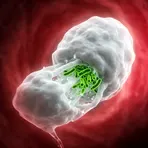 7
6.7
7
6.7
A large white blood cell that eats and removes germs and dead cells
 7
3.5
7
3.5
A blood cell that eats bacteria and fungi to help fight infection
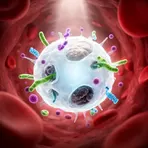 1
7.7
1
7.7
A white blood cell that eats and destroys bacteria and other germs
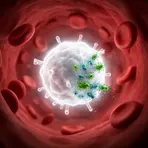

 1
4.6
1
4.6
A blood cell that surrounds and destroys germs
 1
8.6
1
8.6
A white blood cell that eats and digests small germs or particles
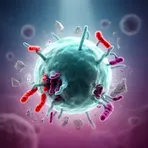 1
8.1
1
8.1
A cell that eats and destroys bacteria and dead cells to help the body's immune system
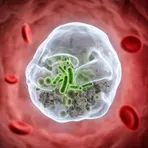 1
5.8
1
5.8
A tiny part of the body that eats dead tissue and germs to help fight infection
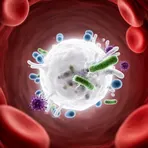
A blood cell that helps protect the body by eating and killing bacteria and other germs

A white blood cell that eats and kills bacteria
Surface Forms
Morphology
leukocyte = leuko + cyte
The word is built from specialist Greek combining forms ('leuko-' and '-cyte') that are not recognizable as standalone English words to an average B1 learner, so the meaning is not derivable from familiar base words.
Etymology
Leukocyte comes from Greek parts leuko- meaning 'white' and -cyte meaning 'cell', so it simply means 'white cell' and refers to the white blood cells that help protect the body.