

monocyte
 2
6.5
2
6.5

- noun
- /ˈmɒnəˌsaɪt/
- Specialized
- a2-M is a large glycoprotein (720 kDa) of plasma and is synthesized by a variety of cell types, including monocytes, hepatocytes, and astrocytes 4.
- monocyte count
- monocytes and lymphocytes
- monocyte and eosinophil
Examples
-
Monocytes are crucial for the immune response, as they help the body eliminate harmful bacteria.
-
IL-32 is also a potent activator of human monocytes and macrophages in synergy with TLR agonists 49.
Blog text (17) -
Her white blood cell count was 10,000, with 14% monocytes.
Academic text (1995) -
Blood panels reveal lymphocyte and monocyte readings consistent with subject's past.
-
In part, these drastic increases are due to the very low basal ACE expression levels in monocytes.
Academic text (2018) -
The increase in the expression of antigen-presenting and costimulatory molecules leads to enhanced accessory functions of monocytes.
Academic text (2014) -
Its prime importance in inflammation, besides the recruitment of neutrophils and monocytes, is to activate these cells to eradicate microbes.
Blog text (15) -
The antimicrobial activity of monocytes actually decreases with maturation to macrophages, whereas it is enhanced upon MGC formation.
Blog text (33) -
Thus, it is currently thought that certain inflammatory conditions, such as those present in the colon of T. muris-infected mice, lead to the recruitment of circulating monocytes that will be the predominant source of IL-4/IL-13-polarized macrophages.
Academic text (2016) -
When the body encounters an infection, monocytes quickly move to the affected area to fight off pathogens.
Synonyms
 22
2.5
22
2.5
A cell in the blood that helps the body fight infections
 9
3.3
9
3.3
A blood cell that eats and kills germs to protect the body
 7
6.7
7
6.7
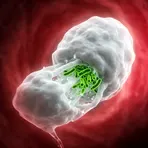
A large white blood cell that eats and removes germs and dead cells
 3
5.4
3
5.4
A white blood cell that helps the body fight infection by eating bacteria and fungi

 1
8.1
1
8.1
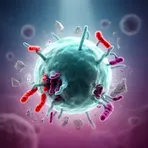
A cell that eats and destroys bacteria and dead cells to help the body's immune system
 1
8.6
1
8.6
A white blood cell that eats and digests small germs or particles
 1
4.6
1
4.6
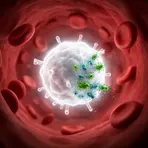
A blood cell that surrounds and destroys germs
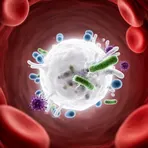
A blood cell that helps protect the body by eating and killing bacteria and other germs
How Big

Surface Forms
Morphology
monocyte = mono + cyte
The word is built from the combining forms mono- and cyte, but it is a specialized biomedical term whose full meaning is not directly inferable for most learners.
Etymology
The word monocyte comes from two Greek parts: mono- meaning 'single' and -cyte meaning 'cell'. So a monocyte is literally a 'single cell', which explains why it is a large white blood cell with one nucleus that helps defend the body by eating bacteria and other invaders.