
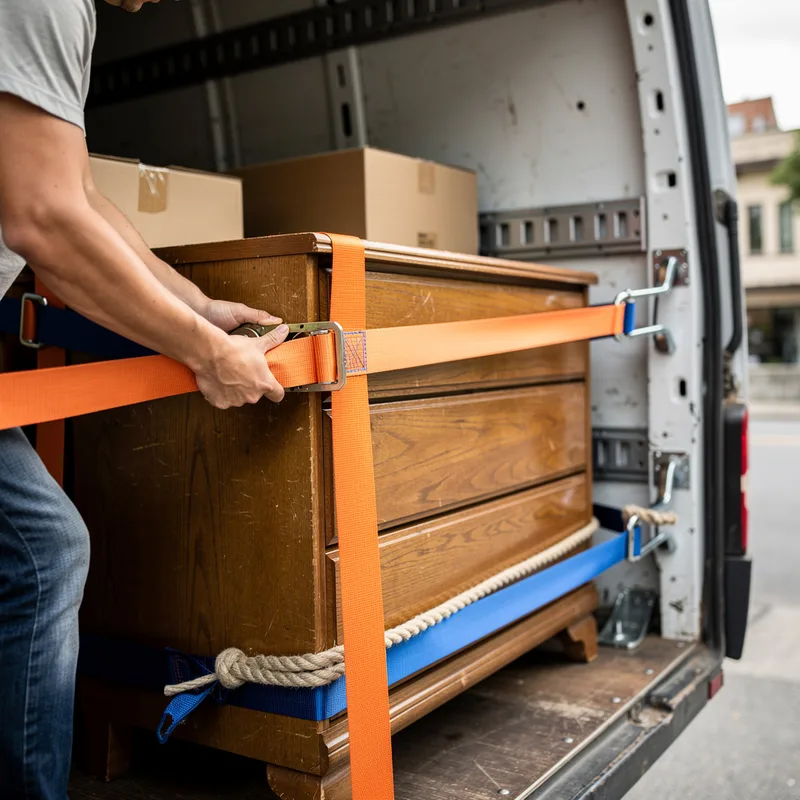
to tie down
 5
4.0
5
4.0

- phrasal verb
- /taɪ daʊn/
- Claude and his younger sister, Evangeline, shuttered shutters and tied down what needed tying down.
- tied down with ropes
- arms and legs tied down
- get tied down
Loading YouTube…
Watch on YouTubeAnd the person is is tied down, naked, pierced by multiple needles.
- And the person is is tied down, naked, pierced by multiple needles.
- For four years he has tied down huge numbers of Allied troops, remaining undefeated while cut off from home.
- But like if I met someone amazing and it was something that had a lot of potential, I'm not tied down to a place right now at all.
Examples
-
You men make sure that's tied down properly, you hear me?
-
I have the Shadow tied down outside the building.
Fiction book (1993) -
We'll tie down the other three on the way back.
-
Get them tied down... ...and go down below!
-
But the trunk was tied down with wire.
-
We've got their main line tied down fairly well.
-
I want to tie down the tarp better. "I'll help you," Will said, rising.
Fiction book (1999) -
Just enough ropes to tie down Gulliver.
Blog text (13) -
I guess our biggest concern was that we had everything tied down so that when we opened the hatch, we didn't have something wandering off into space!
Blog text (31) -
Before the storm hit, we made sure to tie down all the garden furniture to prevent it from blowing away.
Synonyms
 923
1.0
923
1.0
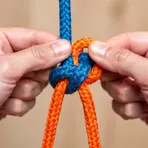
To fasten things together by making a knot with string or rope
 132
3.2
132
3.2
To tie something tightly with rope or string
 86
4.6
86
4.6
Hold a person or thing so it cannot move freely
 74
2.2
74
2.2
Fasten something with rope so it cannot move
 52
2.9
52
2.9
To fasten something with a band so it stays in place
 47
3.3
47
3.3
Fasten something tightly to keep it from moving
 35
6.2
35
6.2
To restrain someone with chains or limit their freedom
 23
4.4
23
4.4
To tie an animal or object so it cannot move away
 22
3.2
22
3.2
To keep something low and stop it from getting bigger
 19
4.6
19
4.6
To tie someone or something with a chain to keep them from moving
 14
4.7
14
4.7
To fasten something securely with rope or cord
 11
1.0
11
1.0
To tie or secure something with a strong cord
 8
5.5
8
5.5
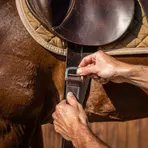
To fasten a strap tightly so it does not slip
 4
7.0
4
7.0
To tie the legs and wings of a bird so it cooks evenly
 4
9.1
4
9.1
To tie a rope to something to hold it for safety, for example when climbing or docking a boat
 4
9.3
4
9.3
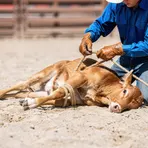
To tie the arms and legs of a person or animal so they cannot move
 1
4.4
1
4.4
To tie things together with rope to hold them in place

To tie something tightly with rope so it does not move

To tie a rope to a metal or wooden fitting to hold it in place

To fasten something like a tent to the ground with small pins
Antonyms


How Restricted
21
6.0
 51
3.4
14
4.7
5
4.0
347
3.3
68
1.6
51
3.4
14
4.7
5
4.0
347
3.3
68
1.6
Surface Forms
Morphology
The meaning 'to limit someone's freedom or independence' is directly related to the literal sense of 'tie' (to bind) combined with the particle 'down' which conveys immobilization or restriction, so a learner who knows both words can infer the general sense. However, the specific nuances (e.g. causing dependence or responsibility) are metaphorical extensions of the literal image and may not be fully predictable without prior exposure.
Etymology
Tie down comes from the literal act of tying something with a rope to hold it down so it cannot move. People would tie down tents, furniture, or cargo to stop them from blowing away or shifting, so the phrase means 'to secure something' or 'to stop it moving'.