

to tie up
 74
2.2
74
2.2

- phrasal verb
- /taɪ ʌp/
- Listen, Axel, did you leave the boat tied up?
- tie up the boat
Loading YouTube…
Watch on YouTubeAnd then long hair you can tie up in a ponytail.
- And then long hair you can tie up in a ponytail.
- You could use this as a shelter, but you don't have any cord to tie anything up with.
- I might need some gel just to tie up these little side pieces, but I think it's pretty good.
- But they have, instead of having buttons, they've got a tie that you tie up and then the bottoms are just matching.
- So like it's in this, you know, shipping box, but then you open it and spelt like cute little raffia and it's all tied up with a cute little Juke twine bow.
- So it's just not as cute when you tie it up.
Examples
-
By the time they reached land and tied up in protected water, all of them were exhausted.
Fiction book (1999) -
Now bring this wire over to that tree, and tie it up about three feet off the ground.
-
I told you to tie him up.
-
I might need some gel just to tie up these little side pieces, but I think it's pretty good.
-
Then you take that, you tie it up and you throw that whole plastic bag into your green bin.
-
Do you see all those horses and mules tied up out there?
Fiction book (1992) -
At our meeting, he handed me a manuscript in a large envelope tied up with string.
Academic text (2011) -
I walked away from our house, carrying my things tied up in an apron.
Fiction book (2001) -
Soon the steamboat was tied up there, and people began to stroll about.
Fiction book (2002) -
We need to tie up the boat securely before the storm arrives.
Synonyms
 923
1.0
923
1.0
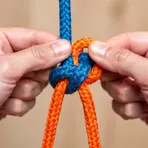
To fasten things together by making a knot with string or rope
 459
2.5
459
2.5
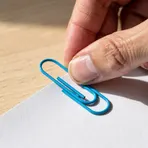
To join or fasten one thing to another so they stay together
 132
3.2
132
3.2
To tie something tightly with rope or string
 88
1.6
88
1.6
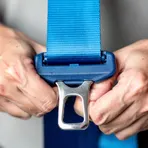
To fasten a belt or strap with a clasp
 68
1.6
68
1.6
Hold something in place so it cannot move
 52
2.9
52
2.9
To fasten something with a band so it stays in place
 51
3.4
51
3.4
To hold something in place so it does not move
 35
1.9
35
1.9
To tie things together with a thin cord
 23
4.4
23
4.4
To tie an animal or object so it cannot move away
 14
4.7
14
4.7
To fasten something securely with rope or cord
 11
1.0
11
1.0
To tie or secure something with a strong cord
 11
5.1
11
5.1
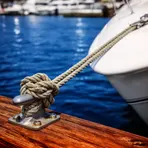
To tie a boat so it does not move
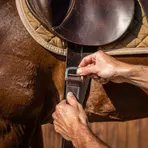 8
5.5
8
5.5
To fasten a strap tightly so it does not slip
 5
4.0
5
4.0
To fasten something with rope or straps to keep it from moving
 4
7.0
4
7.0
To tie the legs and wings of a bird so it cooks evenly
 4
9.1
4
9.1
To tie a rope to something to hold it for safety, for example when climbing or docking a boat
 1
4.4
1
4.4
To tie things together with rope to hold them in place
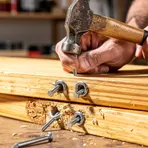 1
4.8
1
4.8
To bend the end of a nail to hold things together
 1
5.5
1
5.5
To fasten something with a strong wire or rope
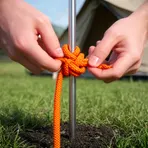

 1
3.2
1
3.2
Fasten a rope or string so it does not come loose

To tie something tightly with rope so it does not move

To tie a rope to a metal or wooden fitting to hold it in place
Antonyms

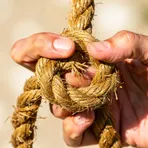
How Secure

Surface Forms
Morphology
tie + up
The sense 'to complete the final details' is a metaphorical extension of 'tie' (to bind) plus the particle 'up' which often signals completion; this makes the relation partially inferable from the parts. However, the specific collocational use (e.g. 'tie up loose ends') is somewhat idiomatic and not fully predictable from the literal meanings, so a B1 learner may need exposure to be sure.
Etymology
Tie up comes from the literal act of fastening a boat with rope: you tie it up so it cannot drift away. So it means 'to fasten' or 'secure'.