

mechanism
 29
8.3
29
8.3

- noun
- /ˈmɛkənɪzəm/
- Formal
- The historical legal mechanism, customary law mediation, had been unable to resolve this dispute for twenty years.
- defense mechanism
- biological mechanism
- psychological mechanism
Examples
-
According to the philosophy of mechanistic science, every natural phenomenon can be explained through a physical mechanism without resorting to supernatural beliefs.
-
Kin selection is the evolutionary mechanism that explains kin-based altruism.
Academic text (2013) -
I mean, if in reality it has to be something to do with the mechanism that brought this universe into being.
-
However, Article 14 is a novel mechanism in any international environmental or other agreement.
Academic text (1998) -
You know, I read somewhere it's like a survival mechanism from the stone age.
-
However, they see community colleges as a mechanism for reproducing inequality.
Academic text (2015) -
Future research needs to examine the causal mechanism underlying these findings.
Academic text (1990) -
The theory of evolution relies on the idea that biological changes are driven by natural processes rather than a divine mechanism.
-
In philosophy, a mechanism refers to the view that all phenomena can be understood solely through physical laws and natural causes.
Synonyms

Belief that physical laws alone explain living things and natural events
Compounds

- Specialized
10
5.3
A mental way a person uses without thinking to reduce strong anxious feelings

- Specialized
4
4.1
A physical trait or behavior that helps animals and plants avoid harm



- Specialized
 1
4.1
1
4.1
A group of parts that controls the direction of a vehicle like a car or bicycle


- Specialized
The mechanical part of a device that makes parts move, like in a piano or toy
- Specialized
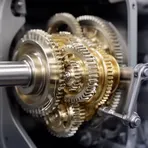
A group of wheels with teeth that pass movement and force to make a machine work


- Specialized
A part that opens by itself to let out pressure and prevent an accident

- Specialized
A way a disease spreads from animals or people to other people
How Mechanistic

Surface Forms
Morphology
mechanism = mechanics (semi-transparent) = mechan + ism
Here '-ism' expresses a theory or doctrine related to 'mechanics'; learners familiar with 'mechanics' can see the link, but the philosophical/doctrinal meaning requires disciplinary knowledge.
Etymology
Mechanism comes from the old Greek root mechan-, meaning 'device' or 'machine', and is like the word machine. In philosophy it uses the image of a machine to say that nature works by parts and physical rules, so the word means things can be explained by physical processes.