
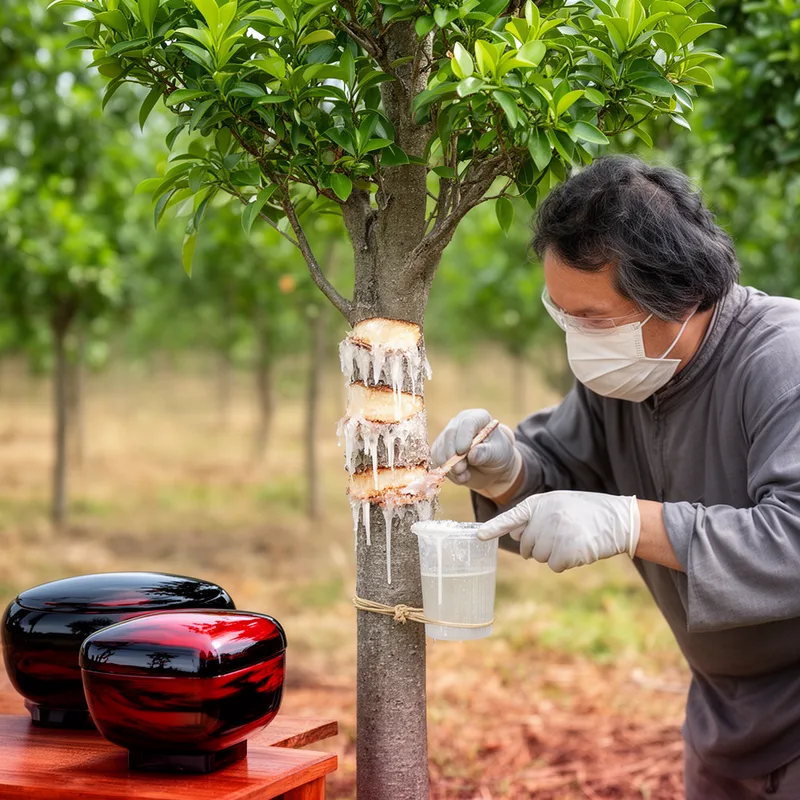
lacquer tree
- noun
- /ˈlæ.kər tri/
- Artisans have relied on the lacquer tree for centuries to produce durable and glossy finishes.
Examples
-
The sap of the lacquer tree is harvested and processed to create traditional Japanese lacquerware.
-
The lacquer tree is known for its toxic sap.
-
Due to its toxic exudate, the lacquer tree must be handled with care during cultivation.
-
Many artisans use lacquer trees to create beautiful finishes.
-
The lacquer tree is known for its toxic sap, which is harvested to create traditional lacquer.
-
Artisans collect sap from the lacquer tree to make stunning lacquerware that showcases intricate designs.
-
In some regions of Asia, the lacquer tree is prized for producing the valuable sap used in fine crafts.
Synonyms

A small Asian tree whose sap makes a hard shiny finish for wood and can cause skin allergy

A small Asian tree that makes a poisonous sap used to make lacquer

A small East Asian tree that makes a poisonous sap used for lacquer

A small tree from China and Japan that makes a poisonous sap used to make a hard shiny coating

A small Asian tree whose sap can cause a skin rash and is used to make lacquer

A small Asian tree that gives a poisonous sap used to make lacquer

A small tree from East Asia that loses its leaves and has toxic sap used to make lacquer
Surface Forms
Morphology
The compound 'lacquer tree' is directly compositional: 'lacquer' (a finish) + 'tree' signals a tree associated with lacquer or that yields lacquerous sap, following common noun+noun naming patterns (e.g. 'apple tree'). Even if 'lacquer' is less frequent, a B1 learner who knows both constituents can readily infer this meaning as a tree used for or producing lacquer.
Etymology
The noun lacquer tree names a small Asian tree that gives a sticky, sometimes poisonous sap which people turn into lacquer, a shiny protective coating. So the name means a tree used 'to make lacquer'.

