

fir tree
 5
2.0
5
2.0

- noun
- /fɪr tri/
- We hiked through the forest, admiring the tall fir trees around us.
- Douglas fir tree
- tall fir tree
- branches of a fir tree
Examples
-
Bears are out there, along with moose and bald eagles, and stands of birch, aspen, and fir trees.
Academic text (2011) -
The north wind whistled and howled loudly through the towering redwood and fir trees.
Fiction book (1995) -
There is an old heavy fir tree standing.
-
A bunch of fir trees over there with a big sign that says...
-
"Out in the woods stood a nice little fir tree."
-
The huge fir trees seemed to float past our car on either road shoulder.
Fiction book (1995) -
The gold ball of the sun was clearing the spiky fir trees visible against the light blue sky.
Fiction book (1991) -
Molly recalled the fir tree cove as a wild place.
Fiction book (2000) -
Beverly watched him walk down the gravel path until he was hidden by the fir trees.
Fiction book (1999) -
Overhead, the boughs of fir trees weave a soughing roof.
Fiction book (1991)
Synonyms
 22
1.6
22
1.6
A tall evergreen tree with needle leaves and upright cones often used as a Christmas tree
 1
4.0
1
4.0
A tall evergreen tree from western North America with short needles and strong wood
 1
4.4
1
4.4
A large evergreen tree with strong wood often used as a Christmas tree


 1
6.7
1
6.7
A tall tree that stays green all year with soft needles and a narrow cone-shaped top
 1
7.8
1
7.8
A small fir tree from the mountains of the eastern United States often used as a Christmas tree
 1
4.9
1
4.9
A medium tree that stays green all year and has a fresh smell, often used as a Christmas tree

A tall evergreen tree with needle leaves and upright cones often used as a Christmas tree

A group of fir trees with needle leaves and upright cones

A group of evergreen trees like firs that grow in cool northern regions

A fir tree from western United States with soft wood and bluish green needles

A medium to tall fir tree that grows in the western United States and has soft wood

A tall fir tree from the Pacific Northwest with long curved branches and deep green leaves

A tall fir tree that grows on the Pacific coast with long curved branches and dark green needles

A very tall evergreen tree from northwest America with long curved branches

A small fir tree from the southern Appalachian Mountains with very short needles

A medium-sized fir tree from northeastern North America with fragrant needles often used as a Christmas tree

A tall fir tree with spiny pointed leaves and cones found only in a small area of California

A medium to tall fir tree that grows in the central and western United States

A tall evergreen fir tree from central and southern Europe often used for wood

A medium to tall evergreen tree that grows in high mountains, with a narrow cone-shaped crown and soft flat needles

A medium to tall fir from western North America with tiered branches and orange-scented needles when crushed

A tall tree with long curved branches and dark green needles that grows on the Pacific coast

A tall tree with long curved branches and dark green leaves that grows by the Pacific coast

A tall evergreen tree from southwestern California with sharp needle-like leaves and cones that have long spines

A rare tall evergreen tree with sharp leaves and spiny cones from southwestern California

A tall evergreen tree from northwestern North America with short needles and egg-shaped cones

A tall evergreen tree from northwest North America with short needles and egg-shaped cones
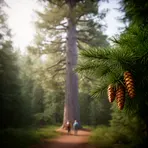
A large evergreen tree from northwestern North America also called Douglas fir with short needles and egg-shaped cones

A tall evergreen tree native to northwest North America with short needles and egg-shaped cones, also called Douglas fir

A tall evergreen tree with flat needles white or silvery underneath and a straight trunk

A medium to tall fir tree with a narrow upright crown and soft wood
How Big

Surface Forms
Morphology
The meaning is directly compositional: 'fir' names a particular needle‑leaved evergreen and 'tree' denotes a woody plant, so together they designate a type of tree. This simple noun+noun subtype formation is cross‑linguistically common and would be immediately understandable to a B1 learner who knows both constituents.
Etymology
Fir tree is a simple name: fir was the word for a tall, needle-leaved tree and tree just means a tree. Because these trees stay green all year and were often brought into homes as a 'Christmas tree', the name fir tree came to mean the familiar evergreen we decorate.