

Douglas fir
 1
4.0
1
4.0

- noun
- /ˈdʌɡləs fɪr/
- US
- A family of squirrels nested high in the branches of the nearest Douglas fir tree.
- Douglas fir forest
- Douglas fir tree
- old Douglas firs
Examples
-
When a Douglas fir tree was attacked by beetles, it produced an anti-feedant chemical, and so did other Douglas firs in distant parts of the forest.
Fiction book (1990) -
Uh, this is a Douglas fir.
-
He once handed me a tiny Douglas fir and asked me to plant it in my yard.
Academic text (2005) -
"We lost about ten percent of the Douglas fir flooring due to splitting or people patching it up over time," says Cook.
Academic text (1998) -
Mary pushed the bandanna away from her ears and looked back along the dirt road cut through a stand of second-growth Douglas fir.
Fiction book (1990) -
A bar was placed underneath the plywood to remove it and expose the one-by-four-inch tongue-and-groove Douglas fir flooring.
Academic text (1998) -
When a Douglas fir tree was attacked by beetles, it produced an anti-feedant chemical, and so did other Douglas firs in distant parts of the forest.
Fiction book (1990) -
As we hiked through the forest, we admired the tall Douglas fir trees that provided shade on a hot day.
-
The carpenter chose Douglas fir for the beams of the new house because of its strength and durability.
Synonyms
 1
4.4
1
4.4
A large evergreen tree with strong wood often used as a Christmas tree

A tall evergreen tree from northwestern North America with short needles and egg-shaped cones

A tall evergreen tree from northwest North America with short needles and egg-shaped cones
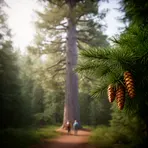
A large evergreen tree from northwestern North America also called Douglas fir with short needles and egg-shaped cones

A tall evergreen tree native to northwest North America with short needles and egg-shaped cones, also called Douglas fir

A tall evergreen tree from northwestern North America with short needles and egg-shaped cones
How Big

Surface Forms
Morphology
Douglas + fir
The compound is a straightforward name: 'Douglas' (a proper name) + 'fir' (a type of tree), so the phrase denotes the fir tree (and its timber) associated with Douglas. This noun-noun naming pattern for species/woods is compositional and cross-linguistically common, so a B1 learner who knows both constituents can reasonably infer it refers to a type of fir/its wood.
Etymology
Douglas fir gets its name from a Scottish plant collector, David Douglas, who sent the tree's seeds to Europe in the 1800s and so people began calling the tall evergreen by his name. That's why Douglas fir now means this specific tall, needle-leaf tree.